

Autumn leaves in Taiwan are easy to overlook if your image of the island is all night markets, tropical coastlines and green mountains. Yet as temperatures fall, parts of Taiwan develop striking seasonal colours, from golden sweet gum and orange-red maple leaves to copper bald cypress reflected in mountain lakes.
The important difference is timing. Taiwan’s fall foliage does not arrive everywhere at once, and many of the best displays appear later than travelers expect. High-elevation farms and mountain forests may begin changing first, while some lower and warmer areas develop their best colours toward the end of the year or even into winter.
At China Shore Excursions, we plan sightseeing around the time cruise travelers actually have ashore. If Taiwan is part of your sailing, you can also explore our Taiwan shore excursions, including private trips from Keelung, Kaohsiung and Hualien cruise ports.
This guide explains where to see autumn leaves in Taiwan, when different foliage areas are usually at their best and which seasonal destinations make sense for cruise passengers.
Does Taiwan Really Have Autumn Leaves?
Yes. Taiwan has a subtropical climate at lower elevations, but its dramatic mountain geography creates very different conditions across the island.
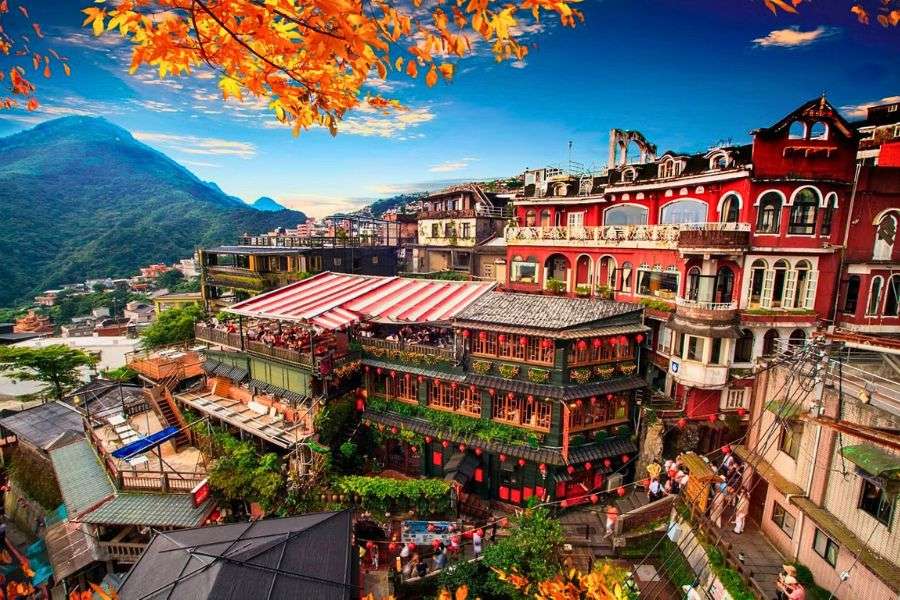
Much of lowland Taiwan stays green throughout autumn. Travel into higher elevations, however, and cooler temperatures support deciduous trees that develop much stronger seasonal colour.
Depending on the location, you may see:
- red and orange maple leaves;
- golden Formosan sweet gum;
- yellow-green and copper transitional foliage;
- reddish bald cypress;
- evergreen forests mixed with patches of autumn colour.
This means Taiwan does not look exactly like Japan, Korea or New England in autumn. You are less likely to find an entire city covered in uniform red foliage. Instead, Taiwan’s strongest autumn scenes are often found in mountain farms, national forest recreation areas, reservoirs and highland landscapes.
When Is the Best Time to See Autumn Leaves in Taiwan?
There is no single peak foliage week for the whole island.
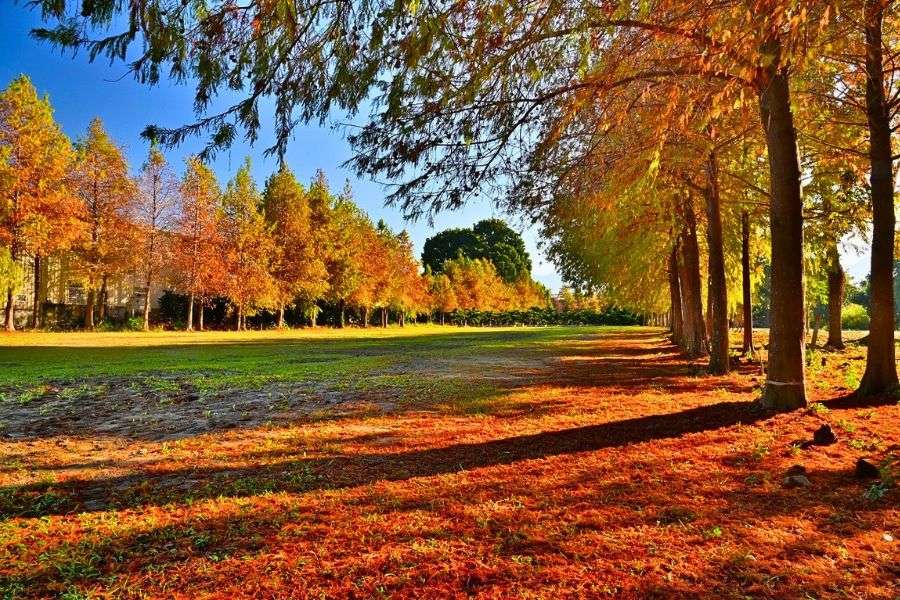
A practical planning window runs from October through December, with some destinations remaining colourful into January. Exact timing depends on elevation, tree species, rainfall and temperatures in a particular year.
| Month | What to Expect |
|---|---|
| September | Usually too early for classic maple foliage, although autumn landscapes such as silver grass begin appearing in mountain areas |
| October | Early foliage can begin at some higher-elevation destinations, particularly selected areas of Fushoushan |
| November | One of the most useful months for mountain foliage, with several major viewing areas entering their seasonal colour period |
| December | Strong foliage remains possible across many well-known destinations, including reservoirs, forests and mountain farms |
| January | Some higher or later-changing locations can still retain colour, while other areas may already have sparse leaves |
If autumn foliage is a major reason for your Taiwan trip, treat these dates as a planning guide rather than a guarantee. Check current conditions shortly before you travel, especially when your itinerary depends on one particular mountain destination.
Why Does Taiwan’s Fall Foliage Season Vary So Much?
Elevation is one of the biggest reasons.
Taiwan rises from warm coastal cities to mountain areas more than 2,000 metres above sea level within relatively short distances. The temperature difference between those environments can be substantial.
Tree species also matter. Japanese maple, Formosan sweet gum, green maple and bald cypress do not necessarily change colour at the same time or in the same way.
Even within one destination, different areas can peak at different times. Fushoushan Farm, for example, has several maple-viewing zones that colour sequentially rather than all becoming red on the same date.
This is why a useful Taiwan autumn foliage guide needs to look at individual destinations instead of simply saying that “November is peak season.”
Best Places to See Autumn Leaves in Taiwan
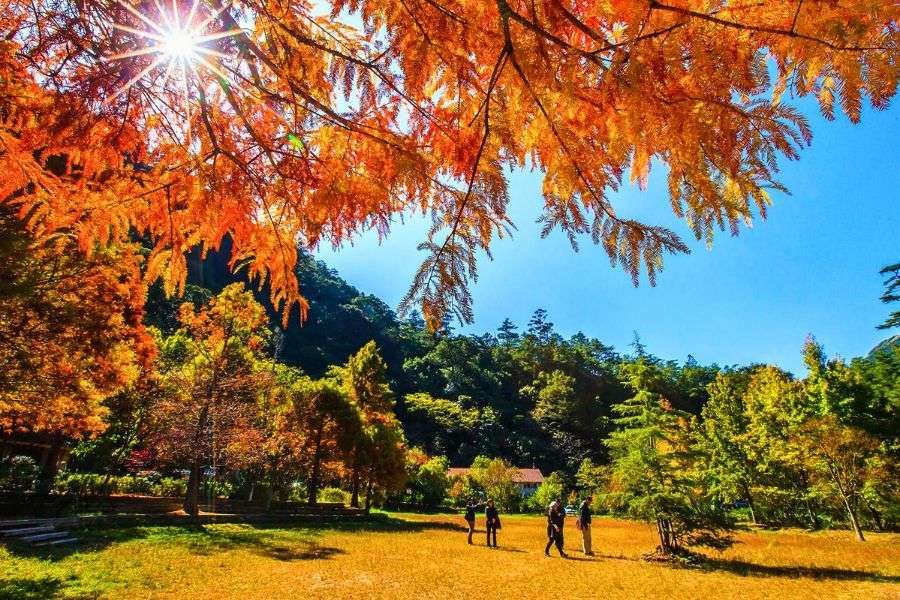
Taiwan has many seasonal foliage locations, but a few destinations stand out because they combine reliable autumn scenery with a strong overall travel experience.
1. Aowanda National Forest Recreation Area
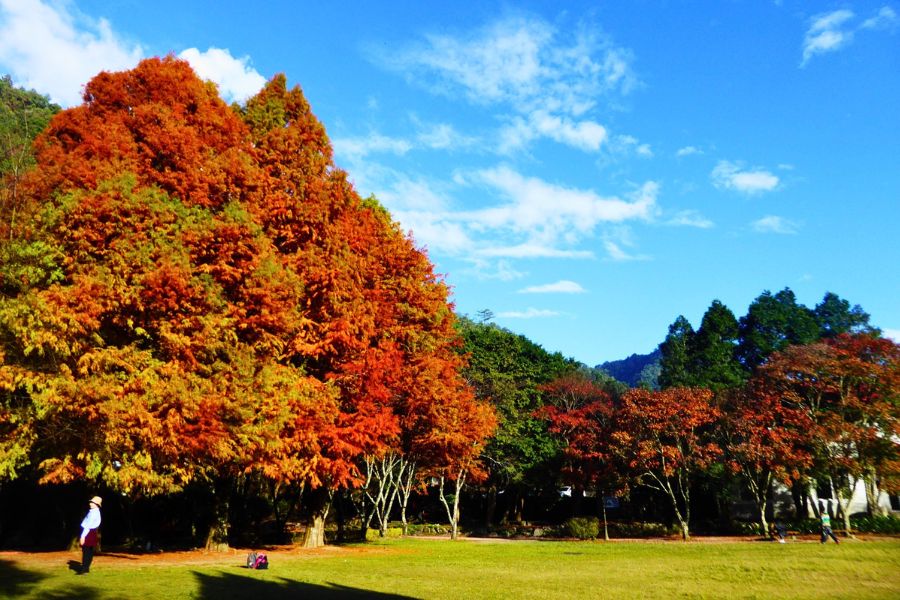
Aowanda National Forest Recreation Area in Nantou is one of Taiwan’s best-known autumn foliage destinations.
The recreation area sits at approximately 1,100 to 1,600 metres above sea level and contains Formosan sweet gum, green maple and deciduous cypress. During the cooler season, these trees create a mixture of gold, orange and red against the surrounding mountain forest.
The Maple Forest Trail is one of the main places to experience the foliage. Rather than a short roadside photo stop, Aowanda works best as a nature destination where visitors have time to walk through the recreation area and enjoy the landscape.
The surrounding scenery also includes forest trails, river valleys and the Aowanda Suspension Bridge, so the trip remains worthwhile for travelers interested in nature even when foliage colour is not perfectly at peak.
Best for: Dedicated foliage trips, nature lovers, photographers and travelers spending time in central Taiwan.
Timing: Late autumn into winter. Conditions vary each year, so check current foliage information before planning a trip purely for red maple leaves.
2. Wuling Farm
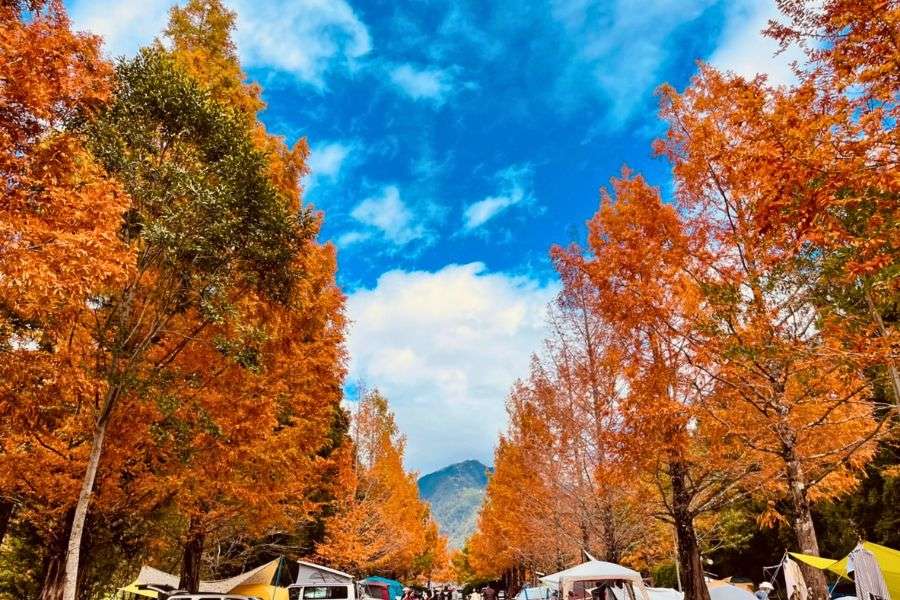
Wuling Farm is one of the strongest choices if you want mountain scenery combined with autumn leaves.
Located in the highlands of Taichung, the farm is surrounded by mountains and has a very different climate from Taiwan’s coastal cities.
Its seasonal landscape changes throughout the year, from spring blossoms to summer greenery and autumn fruit. For maple viewing, the official Taichung tourism information identifies roughly mid-November through mid-January as the best period for enjoying the farm’s flaming maple leaves.
The long viewing window does not mean every tree remains at peak colour for two months. Rather, different foliage areas and weather conditions can create worthwhile scenery across a broader period.
Wuling is especially attractive for travelers who enjoy highland scenery and do not mind travelling farther from Taiwan’s major cities.
Best for: Mountain holidays, overnight trips, photography and travelers combining foliage with a longer central Taiwan itinerary.
Timing: Approximately mid-November to mid-January, with conditions varying during the season.
3. Fushoushan Farm
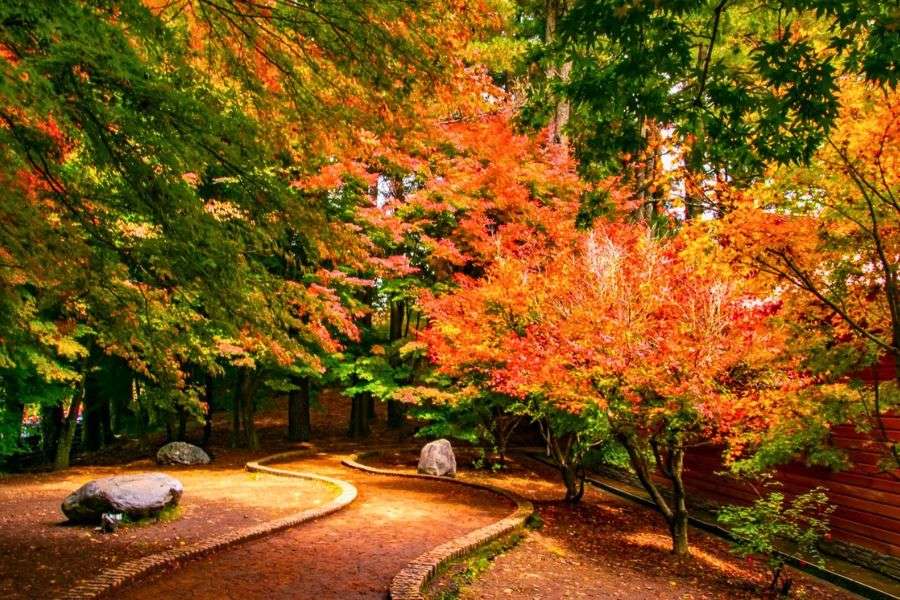
Fushoushan Farm is another important high-elevation foliage destination in the Taichung mountains.
The farm sits more than 2,000 metres above sea level, giving it distinct seasons and cool mountain conditions. In autumn, maple trees around its lakes, trails and historic buildings develop shades of gold, orange and red.
One of the best-known viewing areas is Songlu, where red foliage frames a traditional wooden building and produces one of Fushoushan’s signature autumn scenes.
What makes Fushoushan particularly interesting is that its foliage does not peak everywhere simultaneously. The farm’s own seasonal information explains that different maple areas change in sequence. Areas around Yuanyang Lake can begin earlier, while Songlu generally becomes more prominent later.
As a result, Fushoushan often provides a longer rolling foliage season rather than one short peak.
Best for: Dedicated maple viewing, photographers and travelers comfortable with mountain travel.
Timing: Generally October through November across different sections, with some autumn colour extending later depending on variety and conditions.
4. Alishan
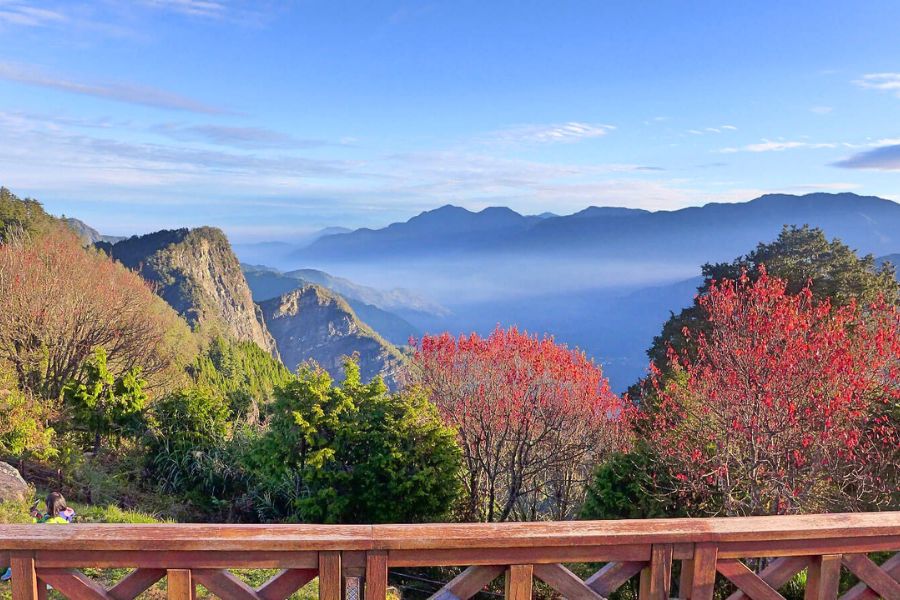
Alishan is famous for sunrises, misty mountain forests, tea plantations and the Forest Railway, but autumn adds another layer to the landscape.
The Alishan National Scenic Area officially lists maple viewing among its autumn experiences. Seasonal colour appears among the area’s evergreen forests, mountain trails and highland scenery.
One reason Alishan works particularly well is that foliage is not the only reason to make the journey. Even if the leaves are slightly before or after their strongest colour, you still have the forest railway, sunrise viewpoints, tea-growing landscapes and mountain walks.
That makes Alishan a more forgiving destination than traveling a long distance solely to photograph one specific maple grove.
Best for: First-time visitors exploring southern Taiwan, overnight mountain trips and travelers who want foliage combined with classic Taiwan scenery.
Timing: Late autumn is the main planning period, with November and December commonly offering seasonal colour depending on elevation and annual conditions.
5. Shihmen Reservoir
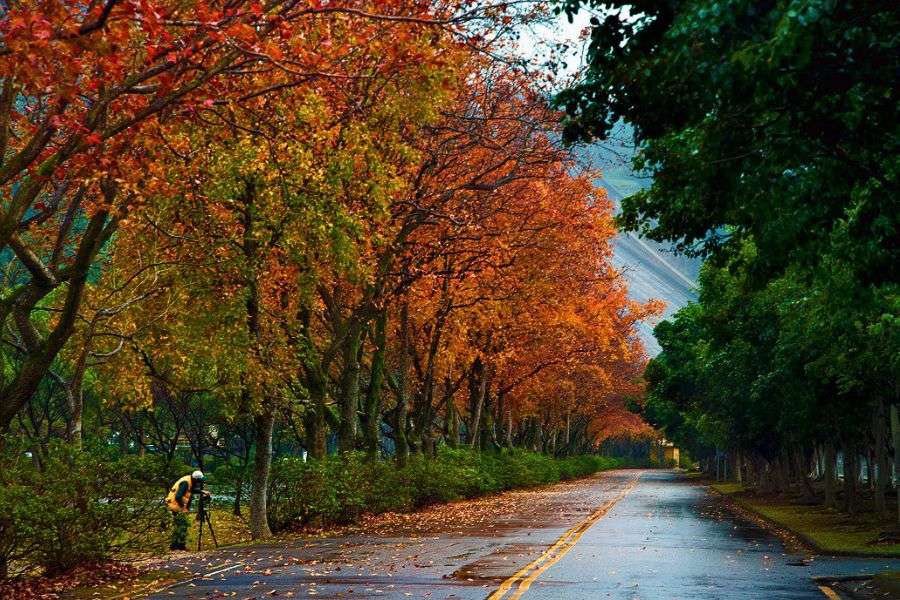
Shihmen Reservoir in Taoyuan is an attractive option for travelers who want autumn foliage without heading as deep into Taiwan’s central mountains.
The reservoir is surrounded by parks, walking areas and mountain scenery. During the cooler part of the year, maple trees around the area develop shades of gold and red.
Official Taoyuan tourism information identifies November to December as the main autumn maple-viewing period, with locations such as Maple Garden and Maple Forest Trail among the recommended spots.
The reservoir also has an advantage for travelers based in northern Taiwan: it can be combined with places such as Daxi rather than requiring an overnight mountain stay.
Best for: Northern Taiwan day trips, travelers staying in Taipei or Taoyuan and visitors wanting a less demanding foliage excursion.
Timing: November to December.
6. Yangmingshan National Park
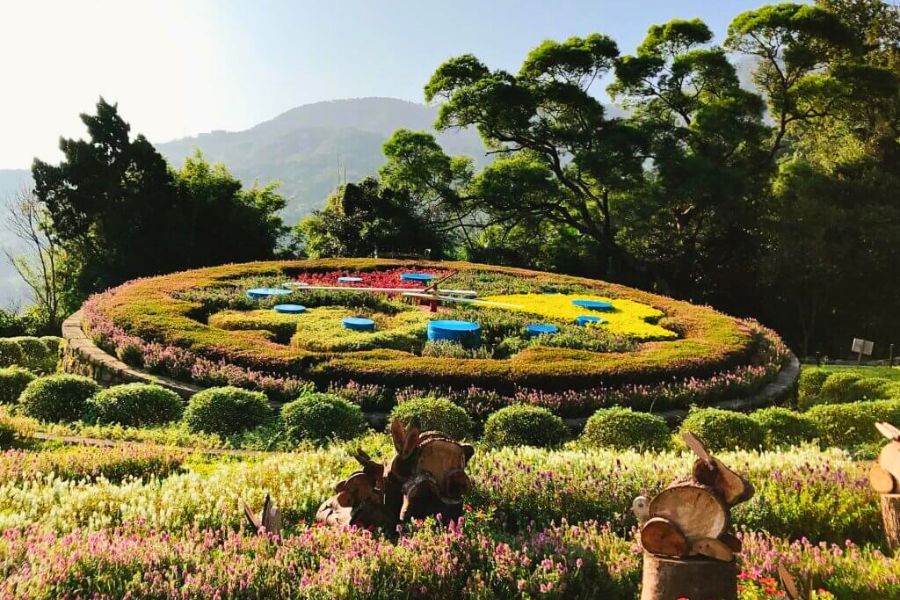
Yangmingshan National Park is one of the most practical seasonal destinations for travelers staying in Taipei or arriving through Keelung cruise port.
Autumn on Yangmingshan is not only about bright red maple leaves. Formosan sweet gum gradually turns yellow, while silver grass begins blooming across areas such as Xiaoyoukeng, Mt. Datun, Lengshuikeng and Qingtiangang after September.
The result is a softer autumn landscape than the fiery red forests of some central Taiwan mountain destinations, but one that is much easier to combine with Taipei sightseeing.
For cruise passengers, this matters. A spectacular maple forest several hours away is not always better than seasonal mountain scenery that can fit safely into the time available ashore.
Yangmingshan can also be combined with city sightseeing depending on the length of your port call.
Best for: Taipei visitors, Keelung cruise passengers, first-time travelers and anyone wanting an accessible northern Taiwan autumn experience.
Timing: Autumn scenery develops from around September onward, with sweet gum and other seasonal vegetation changing as temperatures become cooler.
7. Sun Moon Lake and Xiangshan Bald Cypress
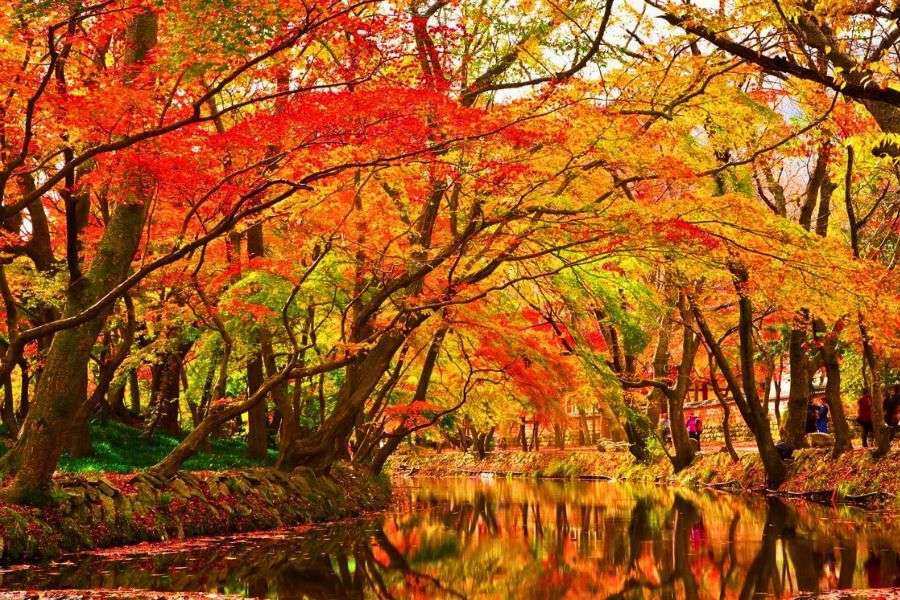
Sun Moon Lake is not primarily a maple destination, but it can provide attractive late-year foliage as part of a broader central Taiwan trip.
The region’s official tourism information highlights maple leaves and bald cypress during November and December. Around Xiangshan Visitor Center, rows of bald cypress add warm yellow and copper tones beside the lake.
The foliage is different from Aowanda’s maple forest. Here, the appeal is the combination of seasonal trees, water and the broader Sun Moon Lake landscape.
For travelers already visiting the lake, this makes autumn and early winter particularly photogenic without requiring a separate foliage-only excursion.
Best for: Couples, relaxed sightseeing, central Taiwan itineraries and travelers who prefer lakeside scenery to mountain hiking.
Timing: November to December for many maple and bald-cypress displays.
Which Taiwan Autumn Foliage Spot Is Best?
| Destination | Best For | Typical Planning Window | Travel Style |
|---|---|---|---|
| Aowanda | Classic forest foliage | Late autumn into winter | Nature-focused trip |
| Wuling Farm | Mountain maples | Mid-November to mid-January | Long day or overnight |
| Fushoushan Farm | Highland maple photography | October to November, varying by area | Dedicated mountain trip |
| Alishan | Foliage + iconic Taiwan scenery | Late autumn | Full-day or overnight |
| Shihmen Reservoir | Accessible northern foliage | November to December | Day trip |
| Yangmingshan | Taipei-area autumn scenery | Autumn into cooler months | Half or full day |
| Sun Moon Lake | Lake + bald cypress | November to December | Relaxed scenic trip |
If your priority is the strongest classic maple experience, look toward central Taiwan’s mountain destinations. If convenience matters more, northern Taiwan offers easier alternatives that can be incorporated into a normal sightseeing itinerary.
Where Can You See Autumn Leaves Near Taipei?
If you are staying in Taipei or arriving at Keelung cruise port, you do not necessarily need to travel to Aowanda or Wuling Farm to experience Taiwan’s autumn season.
The most practical options include Yangmingshan National Park and, with enough time, Shihmen Reservoir.
Yangmingshan is particularly useful because it is close enough to Taipei to combine mountain scenery with other attractions during a full day.
Shihmen Reservoir lies farther from central Taipei, but its November–December maple season makes it a stronger choice for travelers specifically interested in fall colours.
Taipei itself also develops smaller pockets of seasonal colour. Trees along parts of Zhonghua Road can turn yellow, orange and reddish as temperatures fall, while bald cypress around selected city parks and green spaces develop copper tones in the cooler months.
These urban locations will not replace a mountain foliage trip, but they can add seasonal interest without using an entire day.
Autumn Leaves from Keelung Cruise Port
For cruise passengers arriving at Keelung, the best foliage destination is not automatically the most famous one in Taiwan.
Aowanda, Wuling Farm, Fushoushan and Alishan are important autumn destinations, but they are too far from Keelung to recommend casually during a standard cruise call.
Instead, northern Taiwan should be your first consideration.
Yangmingshan National Park is the most practical seasonal option for many cruise travelers. It allows you to experience mountain landscapes without committing most of the day to long-distance transfers.
If your ship has a particularly long call and foliage is your main priority, a farther northern Taiwan destination such as Shihmen Reservoir may be considered after checking actual transfer times.
For first-time visitors, however, we would normally balance seasonal scenery with Taipei’s major attractions rather than using the whole port call purely to chase autumn foliage.
You can explore our Taipei shore excursions from Keelung Port if you want to combine northern Taiwan scenery with sightseeing planned around your ship’s schedule.
Can You Visit Aowanda from a Cruise Ship?
Technically, what is possible on a map and what is sensible during a port call are two different things.
Aowanda is in Nantou in central Taiwan. For a cruise passenger arriving at Keelung in the north or Kaohsiung in the south, a dedicated same-day Aowanda trip would involve substantial transfer time before you even begin exploring the recreation area.
That makes Aowanda much better suited to:
- a pre-cruise Taiwan itinerary;
- a post-cruise land tour;
- an overnight stay in central Taiwan;
- travelers already based around Nantou, Puli or Cingjing.
If your cruise is only stopping in Taiwan for one day, choose scenery that fits naturally with your arrival port instead of trying to reach the most famous foliage location at any cost.
Which Autumn Leaves Are Best from Kaohsiung?
Kaohsiung has a much warmer climate than Taiwan’s high mountain regions, so it is not one of the island’s main maple-viewing destinations.
Travelers arriving by cruise should be cautious about planning a distant mountain foliage trip during a normal Kaohsiung port call.
Alishan is one of the better-known southern and central mountain options, but travel time means it deserves careful consideration rather than being treated as a quick excursion from the ship.
For a first visit to southern Taiwan, Kaohsiung itself, nearby Tainan and local cultural attractions will often provide a better use of limited port time.
You can compare our Kaohsiung shore excursions before deciding whether a longer seasonal trip makes sense for your schedule.
What About Hualien Cruise Port?
Hualien is surrounded by dramatic mountains, but the famous autumn foliage destinations listed in this guide are not simple add-ons to a standard Hualien cruise day.
Mountain roads, driving distances and changing access conditions mean cruise passengers should not assume that a central Taiwan maple location can be reached safely within a typical port call.
For Hualien, build the day around attractions that are realistically accessible from the port and check current road conditions before planning any long-distance mountain route.
Our Hualien shore excursions can be reviewed separately when planning a port day on Taiwan’s east coast.
Is Taiwan’s Autumn Foliage Better in October, November or December?
If you are traveling specifically for colourful leaves, November is the most useful compromise, but it is not universally the best month for every destination.
October can work particularly well at some high-elevation areas such as sections of Fushoushan, while lower or later-changing areas may still be green.
November brings a wider range of possibilities across mountain destinations.
December remains very important in Taiwan. Shihmen Reservoir officially lists November–December for autumn maples, Wuling’s viewing window continues well beyond November, and several central Taiwan destinations can remain colourful during the cooler part of the year.
January can still work at selected places, particularly where the official seasonal window extends later, but conditions become increasingly variable.
Does Taiwan Have Red, Yellow or Orange Autumn Leaves?
All three.
One mistake is to use “red leaves” and “autumn leaves” as if they mean exactly the same thing.
Taiwan’s seasonal trees can produce a broad palette:
- gold and yellow from sweet gum and early transitional foliage;
- orange as chlorophyll fades and leaves move toward stronger autumn colour;
- bright and deep red from several maple varieties;
- copper and reddish-brown from bald cypress;
- mixed green and warm colours when individual trees change at different speeds.
Aowanda’s official forest information, for example, describes maple foliage progressing from golden shades toward orange-red, while its deciduous cypress contributes additional warm seasonal colour.
That mixed palette is one of the characteristics of autumn in Taiwan.
Is Taiwan Like Japan for Autumn Leaves?
Not exactly, and travelers will have a better experience if they do not expect it to be.
Japan has famous urban maple temples, vast deciduous forests and well-established autumn colour forecasts across much of the country.
Taiwan’s lower elevations remain much greener because of the subtropical climate. Its most dramatic foliage often requires travelling into the mountains.
What Taiwan offers instead is variety. In one trip you can combine warm coastal cities, subtropical forest, alpine farms, tea plantations, lakes and red maple scenery.
The season is also often later, giving travelers another opportunity to see fall colours after foliage has already declined in colder parts of East Asia.
Should You Plan a Taiwan Trip Only Around Autumn Leaves?
For most international visitors, no.
Taiwan’s foliage is worth seeking out, but the strongest itinerary combines autumn colour with places that are rewarding in their own right.
That is why destinations such as Alishan, Sun Moon Lake, Yangmingshan and Wuling Farm work so well. Even if foliage conditions are not perfect, there is still something worthwhile to experience.
A trip designed around one specific grove of red trees is more vulnerable to warm weather, heavy rain or a late colour change.
Whenever possible, build seasonal foliage into a broader Taiwan route instead of making your entire trip depend on one predicted peak date.
Autumn Foliage for Senior Travelers
Some of Taiwan’s most beautiful autumn landscapes are in mountain areas, and that can mean winding roads, slopes, stairs and longer walks.
Senior travelers should look beyond photographs when choosing a foliage destination.
Consider:
- driving time from your hotel or cruise port;
- the altitude of the destination;
- how much walking is needed to reach the best foliage;
- whether trails include steep sections or stairs;
- restroom and rest-stop availability;
- whether the day requires repeated long transfers;
- how much time remains for returning to your ship.
For cruise passengers who prefer an easier pace, Yangmingshan or a northern Taiwan scenic drive may be more suitable than a long expedition to a remote highland farm.
How to Choose the Right Taiwan Autumn Leaves Destination
Start with where you will already be in Taiwan.
If you are based in Taipei, look first at Yangmingshan and northern Taiwan.
If you are traveling through Taichung and the central mountains, Wuling and Fushoushan become much more practical.
If your itinerary includes Nantou, Aowanda and Sun Moon Lake can form part of the same broader central Taiwan journey.
If you are visiting Chiayi and Alishan, enjoy autumn colour as part of the mountain experience rather than adding another distant foliage location.
And if you are on a cruise, begin with your port schedule before choosing any destination. A beautiful place is not a good shore excursion if the transfer distance leaves too little margin for returning to the ship.
What to Wear for Taiwan Fall Foliage Trips
Weather can vary dramatically between Taiwan’s cities and mountain foliage areas.
A warm morning in Taipei or Taichung does not mean you will feel equally warm after travelling to a high-elevation farm or forest.
For autumn mountain trips:
- dress in layers;
- bring a light or warmer jacket depending on elevation;
- wear comfortable walking shoes;
- carry rain protection;
- check the mountain forecast, not only the nearest city forecast;
- bring sun protection for clear days;
- carry water for longer trails.
Conditions can also change quickly in the mountains, so flexibility is more useful than dressing only for the temperature you see when leaving the city.
How to Check Autumn Leaf Conditions Before You Go
Taiwan does not have one universal foliage forecast that guarantees the colour at every destination.
For the best information, check the official website or social channels of the destination you plan to visit shortly before departure.
This is particularly useful for places such as Fushoushan, Wuling and Aowanda, where local conditions are much more meaningful than a general Taiwan autumn forecast.
Also check:
- current weather;
- road conditions;
- park opening notices;
- seasonal transportation arrangements;
- trail closures;
- recent photographs or official foliage updates.
If your Taiwan visit is tied to a cruise ship, transfer and road information matters just as much as leaf colour.
Best Taiwan Autumn Leaves for Cruise Passengers
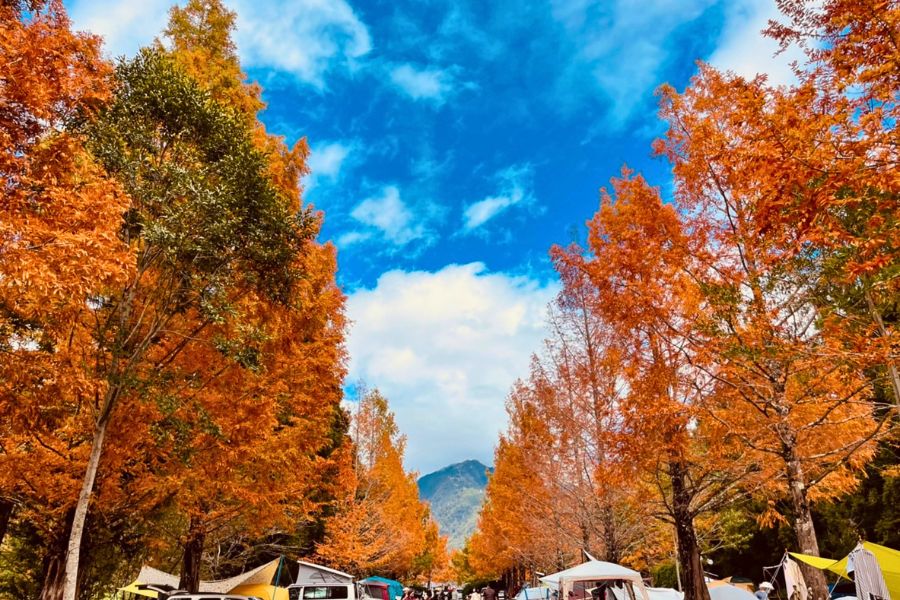
The best foliage destination for cruise travelers is the one that fits the port, not necessarily the destination ranked number one in a general travel article.
| Cruise Port | Practical Autumn Strategy |
|---|---|
| Keelung | Prioritize Yangmingshan or accessible northern Taiwan seasonal scenery |
| Kaohsiung | Do not force a distant mountain maple trip into a short call; prioritize southern Taiwan sightseeing |
| Hualien | Choose destinations based on current road access and realistic transfer time rather than chasing central Taiwan foliage |
| Pre/Post Cruise | Aowanda, Wuling, Fushoushan, Alishan and Sun Moon Lake become much more practical |
For many cruise passengers, a pre- or post-cruise land itinerary is actually the best opportunity to see Taiwan’s famous mountain foliage. Without an all-aboard deadline, you can stay overnight in the highlands and visit the leaves at a more relaxed pace.
Plan Your Taiwan Autumn Trip Around the Season, Not Just the Calendar
Autumn leaves in Taiwan are not defined by one peak date or one famous maple forest.
Fushoushan may begin showing colour while another destination is still largely green. Wuling can remain attractive well into the cooler season. Shihmen Reservoir becomes a useful northern option in November and December, while Aowanda combines maple, sweet gum and cypress in a much more forested setting.
The best approach is therefore to choose the region that already fits your Taiwan itinerary, then check current foliage conditions before committing to a specific viewing spot.
For cruise travelers, the same rule applies with an extra consideration: your ship schedule comes first. A seasonal detour should enhance your port day, not turn it into a race back to the terminal.
Browse our Taiwan shore excursions or explore our Taipei shore excursions from Keelung Port if you would like a Taiwan itinerary planned around your cruise schedule, seasonal interests and preferred walking pace.
Frequently Asked Questions
Does Taiwan have autumn leaves?
Yes. Taiwan has maple, sweet gum, bald cypress and other seasonal trees that develop yellow, orange, red and copper foliage. The strongest autumn colours are generally found in cooler mountain and highland areas rather than Taiwan’s warm coastal cities.
What month is best for autumn leaves in Taiwan?
November is a useful month for many foliage destinations, but there is no single best month for the whole island. Some high-elevation areas begin changing during October, while several destinations remain colourful through December or even into January.
Where is the most famous place to see autumn leaves in Taiwan?
Aowanda National Forest Recreation Area is one of Taiwan’s best-known foliage destinations. Wuling Farm, Fushoushan Farm, Alishan and Shihmen Reservoir are also popular seasonal choices.
When are the maple leaves at Wuling Farm?
Official Taichung tourism information identifies approximately mid-November through mid-January as the best period for enjoying Wuling Farm’s maple foliage.
When are the maple leaves at Fushoushan Farm?
Fushoushan’s maple areas change at different times. The farm generally sees colour from October into November, with earlier and later viewing areas depending on location, maple variety and weather conditions.
Can I see autumn leaves near Taipei?
Yes. Yangmingshan National Park offers accessible autumn mountain scenery close to Taipei, while Shihmen Reservoir in Taoyuan is known for maple foliage during November and December.
Can I see autumn leaves from Keelung cruise port?
Yes. Northern Taiwan options such as Yangmingshan are much more realistic for most Keelung cruise calls than distant central Taiwan foliage destinations. The exact itinerary depends on your ship’s arrival and all-aboard time.
Is Aowanda possible from Keelung cruise port?
Aowanda is in central Taiwan and generally requires too much travel to recommend for a normal Keelung cruise call. It is far better suited to a pre-cruise, post-cruise or overnight central Taiwan itinerary.
Does Taiwan have yellow autumn leaves?
Yes. Taiwan’s foliage includes gold and yellow as well as orange and red. Formosan sweet gum can develop golden tones before turning more orange-red, while bald cypress produces yellow, copper and reddish-brown foliage.
Is Taiwan autumn foliage similar to Japan?
Not exactly. Taiwan remains greener at lower elevations and its strongest fall colours are often concentrated in mountain regions. The foliage season can also arrive later, with worthwhile colour continuing into December and sometimes January.
Should cruise passengers plan a full day just for autumn leaves?
Only when the foliage destination fits the port and the seasonal scenery is a major priority. First-time cruise visitors often benefit from combining accessible autumn scenery with classic sightseeing rather than spending most of a short call travelling to a remote mountain destination.
How can I check Taiwan foliage conditions before visiting?
Check the latest official website or social updates for the specific farm, forest recreation area or scenic destination. Local weather, current photographs, road notices and seasonal updates are more reliable than relying only on a fixed peak date from a previous year.