
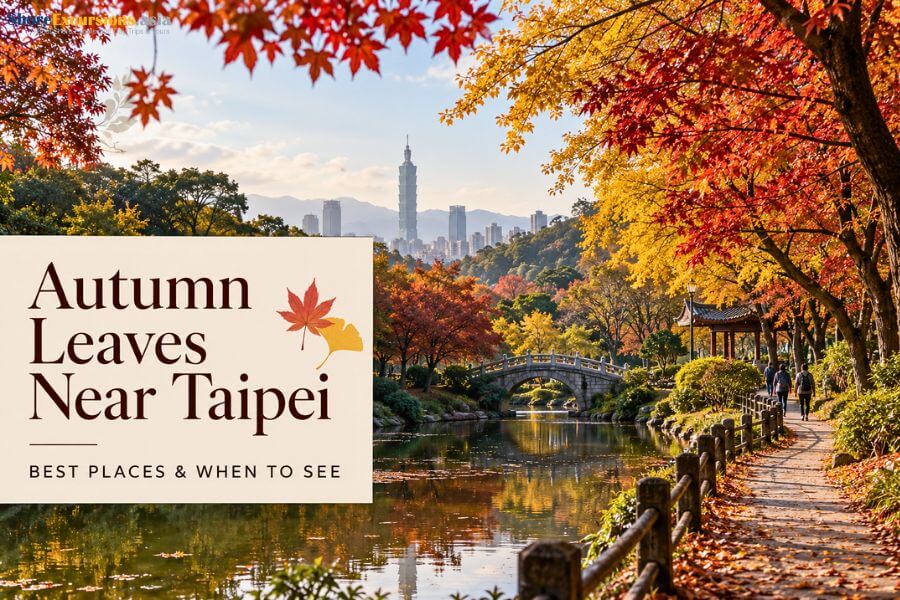
Looking for autumn leaves near Taipei? You do not need to travel all the way to central Taiwan’s famous mountain farms to find seasonal colour. Taipei and northern Taiwan have their own mix of red maple, golden sweet gum, copper bald cypress and late-autumn mountain scenery, with several places suitable for an easy day trip from the city.
The timing is later than many travelers expect. Taipei’s subtropical climate means some trees are still green in October, while stronger red, orange and golden colours often develop from November into December. In some urban parks, bald cypress and maple colour can continue well into January.
At China Shore Excursions, we plan sightseeing around the time cruise travelers actually have ashore. If you are arriving through Keelung, you can browse our Taipei shore excursions from Keelung Port. For a wider look at seasonal destinations across the island, see our guide to autumn leaves in Taiwan.
This guide focuses specifically on Taipei and northern Taiwan foliage spots, including when to visit, how much time each place requires and which locations make the most sense for first-time visitors, cruise passengers and travelers who prefer less walking.
When Is the Best Time to See Autumn Leaves Near Taipei?
For most travelers, November and December are the most useful months to plan around. However, there is no single peak foliage week for the entire Taipei area.
Elevation, tree species and annual temperatures all affect the timing. Mountain locations may begin changing earlier, while lower city parks can hold their strongest colour later into winter.
| Period | What to Expect Near Taipei |
|---|---|
| October | Early mountain-season scenery, silver grass and occasional first colour changes, but many trees remain green |
| November | Autumn colours become more noticeable; good time to begin checking Yangmingshan and northern Taiwan foliage |
| Late November | One of the better periods for maple destinations such as Gongbei Temple |
| December | Strong red, yellow and copper foliage possible at several Taipei and northern Taiwan locations |
| January | Some city maple and bald-cypress displays can remain attractive, although traditional autumn maple areas may begin losing leaves |
If autumn foliage is one of the main reasons for your visit, check recent photographs or official local updates shortly before your travel date. Northern Taiwan’s colour change can shift noticeably from year to year.
Best Places to See Autumn Leaves Near Taipei
The best location depends on the kind of experience you want. Some places are genuine maple-viewing destinations, while others offer seasonal colour as part of a broader mountain, temple or city-park visit.
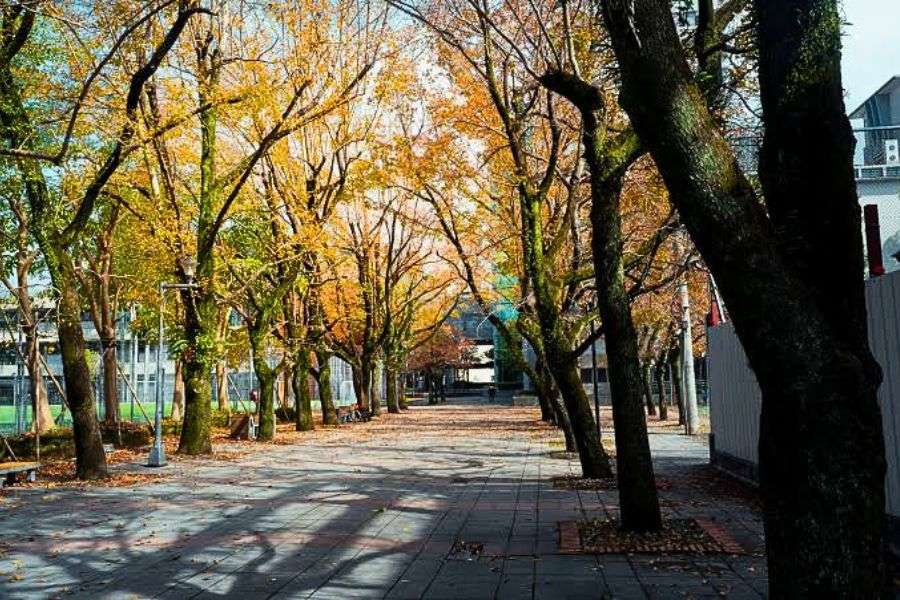
1. Yangmingshan National Park
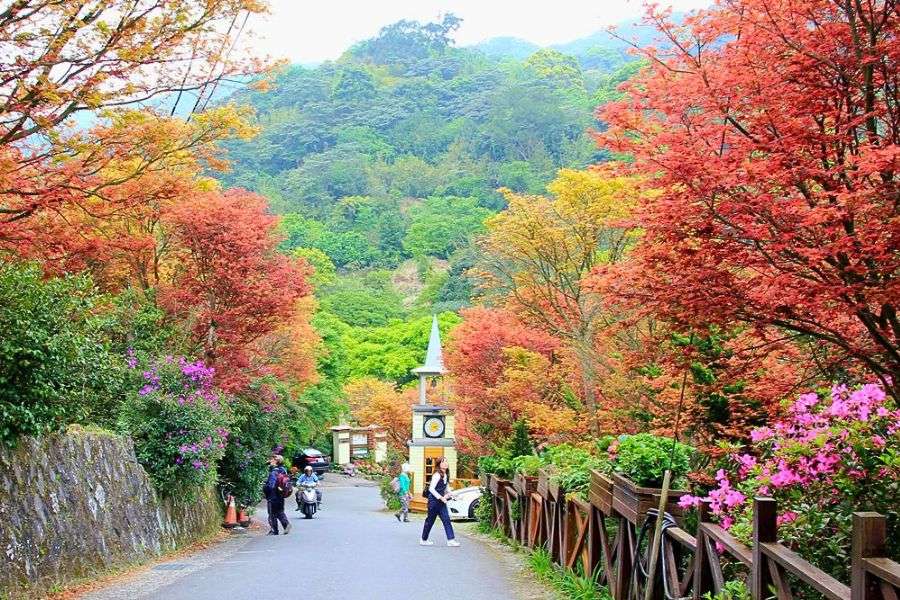
Yangmingshan National Park is one of the most practical places to experience autumn scenery without traveling far from Taipei.
The park sits in the mountains immediately north of the city and offers a mix of volcanic landscapes, grasslands, forest trails, hot springs and seasonal vegetation. In autumn and early winter, ginkgo, maple and other deciduous plants bring yellow and red into a landscape that otherwise remains largely green.
One particularly accessible option is the Ziming Creek Trail. The trail is relatively flat and becomes especially attractive when maple leaves turn red during autumn. Travelers who want a longer outdoor experience can continue into other parts of the Yangmingshan trail network.
Yangmingshan is also well known for silver grass during autumn. Around areas such as Qingtiangang, Lengshuikeng and Xiaoyoukeng, the pale grass creates a different kind of seasonal landscape from a classic red maple forest.
This makes Yangmingshan particularly useful for first-time visitors. Even if the maple colour is not at its strongest, the national park still offers volcanic scenery, mountain views and other reasons to visit.
Best for: First-time visitors, Keelung cruise passengers, mountain scenery and travelers who want autumn colour without dedicating an entire day purely to maple viewing.
Best time: Autumn into early winter. Exact maple colour varies with temperature and elevation.
2. Gongbei Temple in Xizhi
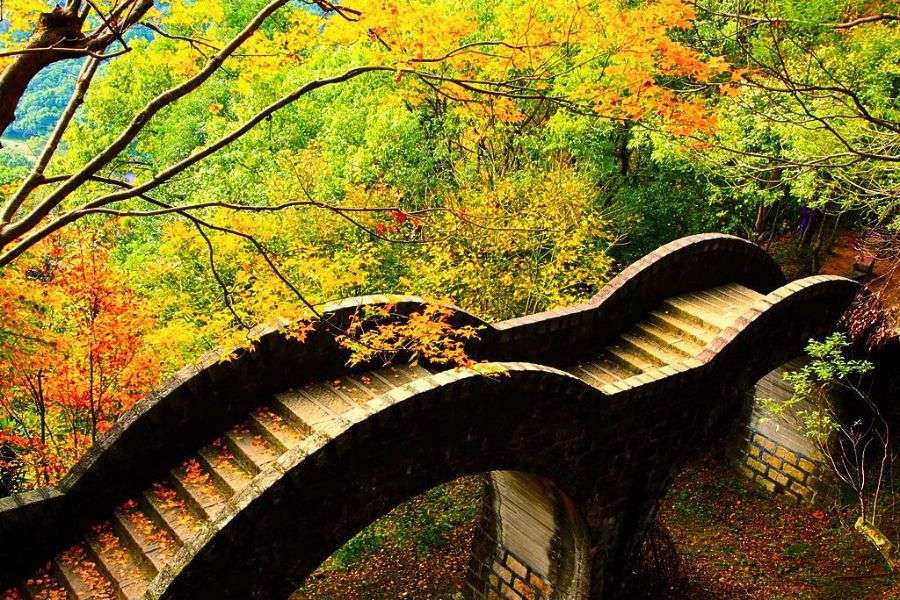
Gongbei Temple is one of the most interesting dedicated maple-viewing spots in northern Taiwan and deserves more attention from international travelers.
Located in Xizhi, New Taipei City, the century-old temple is surrounded by maple trees that turn red as colder weather arrives. The combination of foliage, stone lanterns, temple architecture and an elegant double-arch bridge gives the area a very different atmosphere from Taipei’s urban parks.
Official New Taipei tourism information identifies approximately late November through late December as the main maple-viewing season, with seasonal colour sometimes extending around the New Year depending on conditions.
The temple also has walking paths and higher viewpoints over Xizhi and the surrounding mountains. You do not need to complete a major mountain hike to appreciate the setting, although parts of the site include stone steps and uphill walking.
Gongbei Temple is particularly interesting for cruise passengers because Xizhi lies between the wider Taipei metropolitan area and Keelung. That makes it geographically more realistic than trying to reach famous maple destinations deep in central Taiwan during one port call.
Best for: Red maple photography, returning visitors, cultural scenery and longer Keelung port calls.
Best time: Late November to late December, sometimes extending into early January depending on the year.
3. Shihmen Reservoir
Shihmen Reservoir in Taoyuan is one of northern Taiwan’s better-known autumn maple destinations.
The large reservoir combines water, hills and seasonal foliage. During the cooler part of the year, maple trees develop golden and red tones around selected parts of the reservoir.
Official Taoyuan tourism information identifies November to December as the main autumn maple-viewing period. Recommended viewing areas include the Maple Garden, Maple Forest Trail and sections around Gaoxian Highway.
Unlike a single garden or city street, Shihmen works better as a scenic half-day or full-day destination. You can walk beside the reservoir, enjoy mountain views and potentially combine the visit with Daxi Old Street if your schedule allows.
For travelers staying in Taipei, Shihmen is a reasonable northern Taiwan day trip. For cruise passengers arriving at Keelung, however, it requires significantly more driving than Yangmingshan or Xizhi, so the decision should depend on your actual port time.
Best for: Dedicated autumn day trips, photography, reservoir scenery and travelers with more time.
Best time: November to December.
4. Daan Forest Park
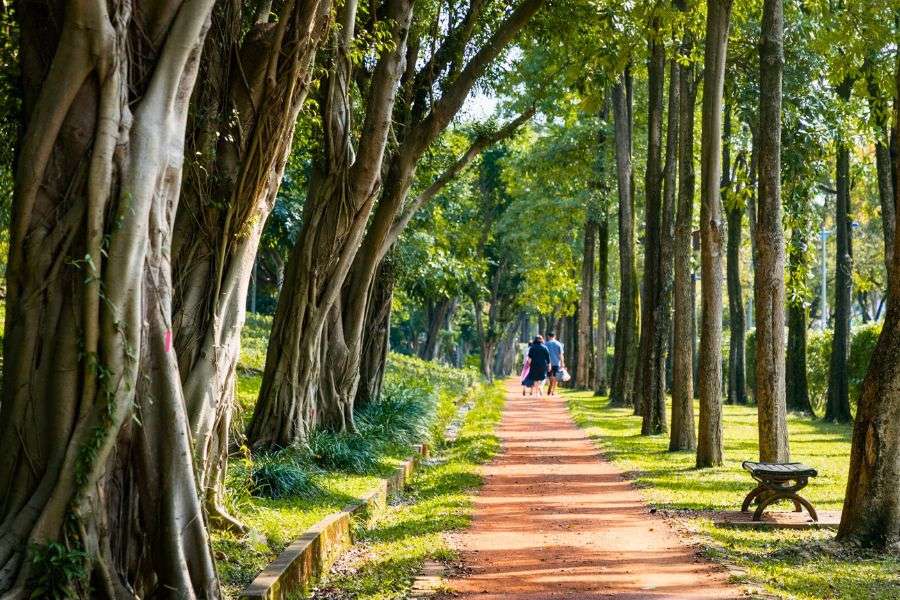
If you want seasonal colour without leaving Taipei, Daan Forest Park is one of the easiest choices.
The park is located in central Taipei and contains bald cypress beside its ecological pond. As cooler weather arrives, the fine green foliage gradually changes through yellow and warm reddish tones.
This is not a dramatic mountain maple forest, and it should not be presented as one. Its value is convenience.
You can add Daan Forest Park to a normal Taipei sightseeing day without sacrificing several hours to transportation. Taipei 101, central neighborhoods and other city attractions can remain part of the same itinerary.
Bald cypress in Taipei generally begins changing from November, with richer yellow, copper and red-brown tones developing through winter.
Best for: Short visits, first-time travelers, easy walking and anyone who wants seasonal colour without leaving central Taipei.
Best time: November into January, with timing varying by temperature.
5. Youth Park
Youth Park is another useful Taipei option that rarely appears in international autumn foliage lists.
The park contains a developing maple grove on the eastern side of its baseball area. As the leaves change and eventually fall, they create an autumn-winter scene within an otherwise urban recreational park.
The park has broad, relatively level paths and a large amount of open space, making it easier to adapt for travelers who prefer a gentler walking pace.
You would not travel halfway across Taiwan solely to visit Youth Park for foliage. But that is exactly why it can work well for some cruise passengers. It can add a seasonal stop to a wider Taipei itinerary without consuming most of the available day.
Best for: Easy-paced sightseeing, urban foliage, seniors and travelers already exploring central Taipei.
Best time: Late autumn into winter, depending on annual temperatures.
6. Maple Tree Lake in Tamsui
Despite its name, Maple Tree Lake is not actually a lake. The name comes from the area’s terrain and the large fragrant maple trees historically found near its entrance.
The site lies in Tamsui, New Taipei City, with mountain slopes and rural vegetation creating a more natural setting than central Taipei.
Green maple trees grow along the walking trail and turn red before falling during autumn. The area also contains old trees and seasonal flowering plants, making it attractive for visitors who enjoy quieter countryside walks.
Tamsui itself is already a worthwhile destination for riverside scenery and old streets, so Maple Tree Lake can make sense for travelers planning a northern or western Taipei-area day rather than making a dedicated foliage trip.
Best for: Returning visitors, countryside scenery and travelers combining autumn foliage with Tamsui.
Best time: Autumn, with colour depending on the year’s temperatures.
7. Manyueyuan National Forest Recreation Area
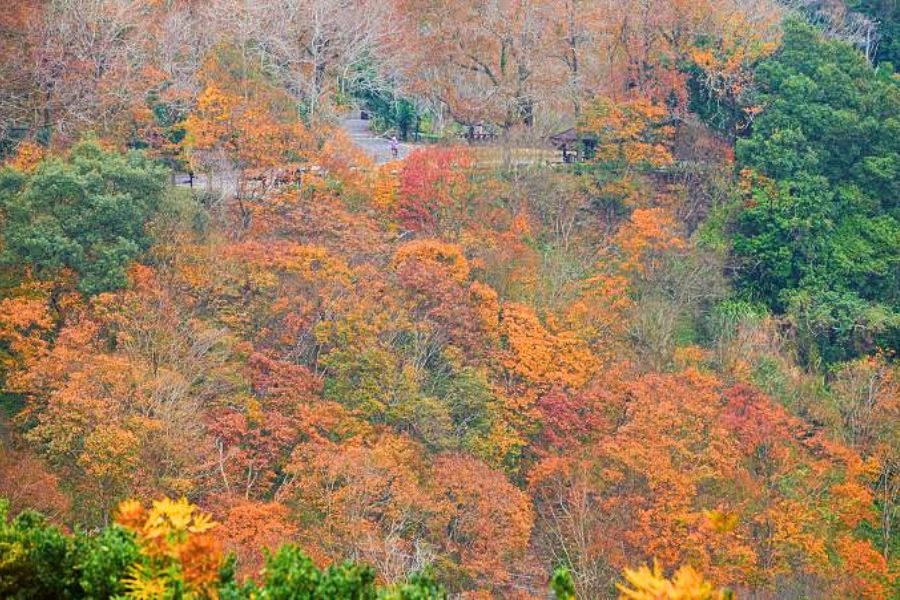
For travelers who want a more substantial forest experience, Manyueyuan National Forest Recreation Area in Sanxia offers waterfalls, mountain forest and maple viewing.
The recreation area ranges significantly in elevation and contains a variety of forest environments. A designated walking route allows visitors to appreciate maple foliage alongside birdlife and mountain scenery.
This is much more of an outdoor excursion than visiting Daan Forest Park or Gongbei Temple. Travelers should expect proper forest walking and allow enough time for the journey from Taipei.
For a cruise port day from Keelung, Manyueyuan would normally be considered only when the ship has a long call and nature is a major priority. It is better suited to travelers staying in Taipei for several days or enjoying a pre- or post-cruise visit.
Best for: Hiking, waterfalls, forest scenery and travelers with a full day available.
Best time: Late autumn and the cooler months, depending on current maple conditions.
Which Taipei Autumn Leaves Spot Should You Choose?
| Place | Best For | Walking | Best Timing |
|---|---|---|---|
| Yangmingshan | Mountain scenery + seasonal colour | Easy to moderate depending on route | Autumn to early winter |
| Gongbei Temple | Classic red maple photography | Moderate with steps | Late Nov–Dec |
| Shihmen Reservoir | Dedicated northern Taiwan foliage trip | Easy to moderate | Nov–Dec |
| Daan Forest Park | Central Taipei + easy seasonal stop | Easy | Nov–Jan |
| Youth Park | Easy urban maple experience | Easy | Late autumn–winter |
| Maple Tree Lake | Rural scenery + Tamsui | Moderate | Autumn |
| Manyueyuan | Forest hiking + maples | Moderate | Late autumn |
What About Taipei Aowanda?
The name Taipei Aowanda naturally makes many travelers assume that it is Taipei’s main autumn maple destination.
The reality is more interesting.
Taipei Aowanda does have extensive maple planting, but its most famous bright red maple display occurs during March and April. Many of its maples are grafted Japanese varieties that develop red foliage during spring, which is why the garden is often promoted as a place where visitors do not need to wait until autumn to see red maple colour.
Taipei’s official tourism site also lists November and December among suggested visiting months, so an autumn visit can still be pleasant. However, travelers searching specifically for the most reliable late-year red maple experience should not automatically assume that Taipei Aowanda works like Aowanda National Forest Recreation Area in central Taiwan.
The two destinations are completely different places.
Are Taipei’s Autumn Leaves Mostly Maple?
No. This is an important distinction.
Autumn and winter colour around Taipei comes from several different kinds of trees and plants.
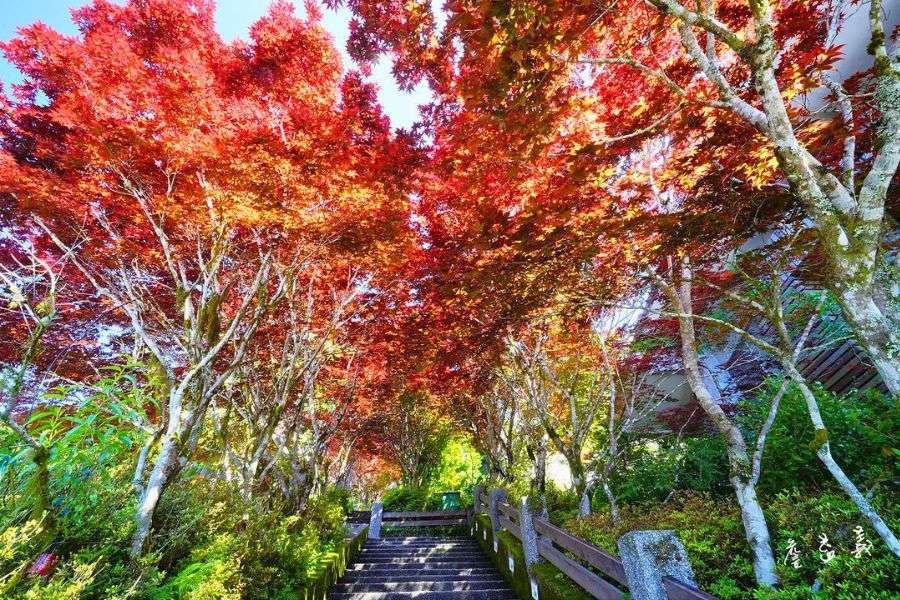
You may see:
- maple turning yellow, orange and red;
- sweet gum bringing yellow and warm-red foliage to mountain areas;
- bald cypress changing from green to gold, copper and reddish-brown;
- ginkgo providing pockets of golden yellow;
- silver grass covering parts of Yangmingshan with pale seasonal tones.
That is why Taipei’s autumn scenery often looks more mixed than the dense crimson maple landscapes associated with some parts of Japan.
Does Taipei Have Autumn Leaves in October?
Yes, but October can be early for strong red foliage in many lower-elevation areas.
Yangmingshan and other mountain environments begin showing more obvious seasonal changes as the weather cools, and autumn silver grass can already be an important part of the landscape.
However, if your main goal is red maple photography, late November and December generally provide more opportunities around northern Taiwan.
Travelers visiting in October should therefore choose locations that are worthwhile even without peak red leaves rather than designing the entire day around one predicted maple grove.
Is November or December Better for Taipei Autumn Leaves?
For dedicated foliage viewing, late November through December is often the more useful window.
Gongbei Temple’s official maple-viewing season begins around late November. Shihmen Reservoir identifies November and December for autumn maple. Bald cypress around Taipei also begins developing stronger warm colour during this period.
December can therefore offer a wider selection of red, orange, golden and copper foliage than early autumn.
However, individual destinations behave differently. If you are traveling for one specific place, check recent conditions rather than choosing solely by month.
Can You Still See Autumn Colours in Taipei in January?
Yes. Taipei’s foliage season often blends into winter.
This is one of the most important differences between Taipei and cooler East Asian destinations.
Bald cypress can remain yellow, copper or red-brown into January, and Taipei City has documented maple foliage around streets and parks turning yellow, orange and red during January after colder weather arrives.
By this point, some traditional maple-viewing destinations may have begun losing leaves, so January travelers should focus more on current conditions and urban winter foliage rather than expecting every autumn site to remain at peak.
Best Autumn Leaves Near Taipei for Cruise Passengers
Cruise passengers arriving at Keelung should choose foliage differently from travelers staying in a Taipei hotel for several nights.
The best-known Taiwan maple destination is not automatically the best shore excursion.
Driving several hours into the central mountains for a famous red forest makes little sense if most of the port call is spent inside a vehicle.
For a Keelung arrival, we would generally prioritize:
- Yangmingshan for the strongest combination of accessibility, seasonal nature and broader sightseeing value.
- Gongbei Temple when red maple is the main priority and the seasonal colour is good.
- Central Taipei parks when the port call is shorter or the group prefers an easier pace.
- Shihmen Reservoir only when the call is long enough to justify the additional transfer time.
This approach gives cruise passengers a better balance between foliage and the other experiences that make northern Taiwan worth visiting.
Best Option for a 4 to 5-Hour Keelung Port Call
With only four or five usable hours ashore, do not build the day around a distant maple destination.
A better plan is to focus on Taipei or the areas closer to the route from Keelung.
Depending on your interests and traffic, a seasonal stop can be combined with one or two city highlights rather than replacing the entire sightseeing day.
For first-time visitors, Taipei 101, a cultural landmark and an accessible city foliage location will usually provide more value than spending most of the port call driving toward a remote forest.
Best Option for a 7 to 8-Hour Keelung Port Call
Seven to eight usable hours gives you considerably more flexibility.
Yangmingshan becomes a strong option because a mountain visit can be combined with selected Taipei attractions.
A possible seasonal itinerary could include:
- Pickup from Keelung cruise port
- Yangmingshan National Park
- A seasonal maple, ginkgo or silver-grass area depending on current conditions
- Taipei city sightseeing
- Local lunch
- One major Taipei landmark
- Return to Keelung with planned buffer time
If the maple conditions at Gongbei Temple are particularly good, a Xizhi-focused seasonal stop can also be considered instead of travelling farther west.
Best Option for a Long Port Call
With nine to ten usable hours or more, you have more freedom to dedicate a substantial part of the day to northern Taiwan’s autumn scenery.
Shihmen Reservoir becomes more realistic, especially if foliage is the main reason for your visit. Another option is a deeper Yangmingshan and Beitou combination with fewer city landmarks.
Even with a long call, we would still avoid trying to reach famous central Taiwan destinations such as Aowanda or Fushoushan from Keelung. Those places are far better suited to pre-cruise, post-cruise or overnight land travel.
Which Autumn Spot Is Best for First-Time Visitors?
For most first-time Taipei visitors, Yangmingshan is the strongest choice.
The reason is not that it always has the reddest maple leaves. It is that the destination remains worthwhile even if the exact foliage timing is imperfect.
You can experience mountain scenery, volcanic landscapes, grasslands and cooler weather while still keeping enough flexibility to include Taipei’s major attractions.
Gongbei Temple is a better choice when red maple itself is the priority. Shihmen Reservoir suits travelers prepared to dedicate more of the day to seasonal scenery.
Best Autumn Leaves for Returning Taipei Visitors
Returning visitors have more reason to move beyond the standard Taipei landmarks.
If you have already visited Taipei 101, the National Palace Museum and Chiang Kai-shek Memorial Hall, a seasonal trip to Gongbei Temple, Shihmen Reservoir or Manyueyuan can reveal a much quieter side of northern Taiwan.
Tamsui and Maple Tree Lake can also work well for a slower day focused on local atmosphere rather than landmark sightseeing.
Autumn Leaves Near Taipei for Seniors
Seeing autumn colour does not need to mean a difficult mountain hike.
For senior travelers or anyone who prefers limited walking, the most suitable locations are generally those where vehicle access and level paths can form a larger part of the day.
Consider:
- Daan Forest Park for easy urban walking;
- Youth Park for broad park paths and a relaxed pace;
- selected Yangmingshan stops rather than a long trail;
- Shihmen Reservoir with a vehicle-based sightseeing plan if transfer time is acceptable.
Gongbei Temple can be beautiful, but travelers should be comfortable with steps and uphill sections. Manyueyuan is better suited to guests who genuinely enjoy forest walking.
Tell your guide about walking limitations before the day begins so the seasonal itinerary can be adjusted around the least mobile person in the group.
Can You Combine Autumn Leaves with Taipei 101?
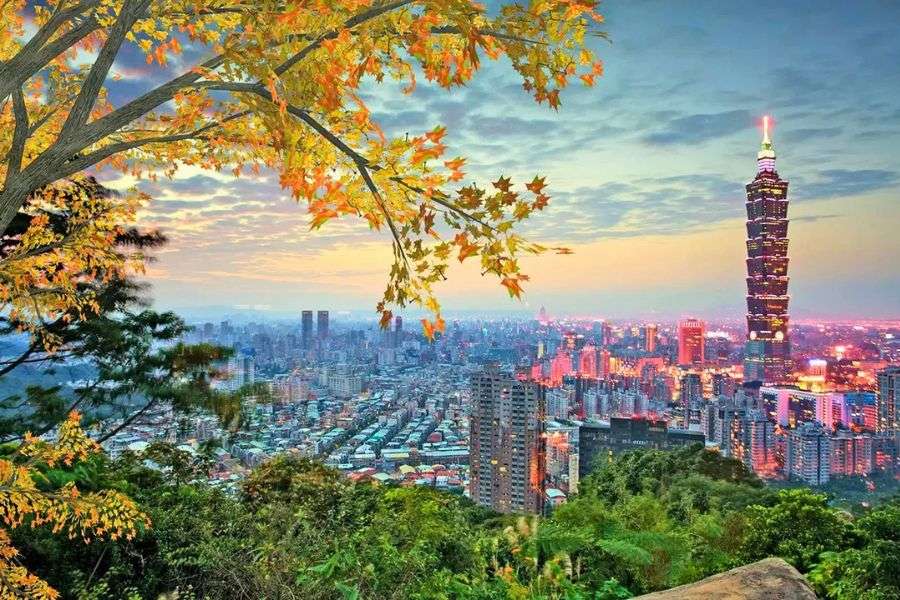
Yes, and for many first-time cruise passengers this is the better strategy.
An autumn foliage stop does not need to become the entire itinerary.
With enough time, a day can combine seasonal scenery with one or two of Taipei’s signature attractions. Yangmingshan is particularly useful for this because it lies relatively close to the city.
Our Taipei Highlights Tour normally focuses on major city landmarks and can provide a useful starting point when considering how a seasonal stop might fit into a private itinerary.
Should You Choose Yangmingshan or Shihmen Reservoir?
Choose Yangmingshan if:
- you are visiting Taipei for the first time;
- you are arriving at Keelung cruise port;
- you want to combine autumn scenery with city sightseeing;
- you value mountain landscapes even if maple colour is not at peak.
Choose Shihmen Reservoir if:
- autumn foliage is one of your main priorities;
- you have a full day available;
- you have already explored central Taipei;
- November or December conditions are favourable;
- you prefer lake and reservoir scenery.
Should You Choose Yangmingshan or Gongbei Temple?
This choice depends largely on what you mean by “autumn experience.”
Yangmingshan gives you a broad seasonal landscape with mountains, grasses, forest and selected maple or ginkgo colour.
Gongbei Temple is more focused. During the main viewing period, the attraction is specifically the combination of red maple, temple architecture and its distinctive stone bridge.
For a first visit, Yangmingshan is more versatile. For a returning visitor or photographer specifically chasing red leaves, Gongbei Temple can be the more interesting choice.
Why You Should Not Travel to Aowanda from Taipei for a Short Foliage Day
Aowanda National Forest Recreation Area is one of Taiwan’s most famous maple destinations, but it is located in Nantou in central Taiwan.
It is not the same place as Taipei Aowanda, and it is not a simple Taipei suburban attraction.
Travelers staying in Taiwan for several days can certainly build Aowanda into a central Taiwan itinerary. Cruise passengers or visitors with only one free day in Taipei should normally choose a northern Taiwan destination instead.
This is a good example of why the best autumn leaves near Taipei are not necessarily the same as the best autumn leaves in Taiwan overall.
What to Wear for Autumn Foliage Trips Near Taipei
Do not assume the temperature in central Taipei will match the temperature in the mountains.
Yangmingshan and other elevated areas can be cooler, wetter and windier than the city.
- Dress in layers.
- Bring a light jacket or warmer outer layer in late autumn.
- Wear comfortable walking shoes.
- Carry light rain protection.
- Check the mountain forecast before departure.
- Bring water for longer trails.
- Allow extra grip and time after rain, particularly on steps and forest paths.
How to Check Taipei Autumn Leaf Conditions
There is no single official foliage forecast covering every maple tree around Taipei.
The most useful approach is to check information from the specific destination shortly before visiting.
Look for:
- recent official tourism updates;
- current photographs;
- local park or attraction announcements;
- weather and temperature trends;
- road or trail restrictions;
- opening hours for managed gardens and recreation areas.
For cruise passengers, also check your ship’s latest arrival and all-aboard times before committing to a longer seasonal excursion.
Is It Worth Planning a Taipei Trip Around Autumn Leaves?
Autumn leaves can add something special to Taipei, but they should usually enhance the trip rather than control the entire itinerary.
Northern Taiwan’s foliage is more variable and later than the classic autumn colours of colder destinations. Much of the landscape remains green, while red, yellow and copper appear in selected mountain areas, temples, parks and reservoirs.
That mixture is part of the appeal.
A first-time traveler can combine autumn scenery with Taipei’s food, culture and famous landmarks. Returning visitors can dedicate more time to Gongbei Temple, Shihmen Reservoir or a forest excursion.
For cruise passengers, the right foliage destination is the one that fits your ship schedule and still leaves a comfortable return to Keelung.
Plan an Autumn Shore Excursion from Keelung
If your cruise calls at northern Taiwan during late autumn or early winter, seasonal foliage can be incorporated into a private port-day itinerary when conditions are suitable.
For most first-time visitors, Yangmingshan provides the best balance of accessibility and seasonal scenery. Gongbei Temple becomes particularly attractive during its red-maple period, while Taipei’s city parks offer easier alternatives for guests who prefer limited walking.
If foliage is your main priority and the ship stays long enough, a farther northern Taiwan destination such as Shihmen Reservoir can also be considered.
Browse our Taipei shore excursions from Keelung Port or Taiwan shore excursions if you would like an itinerary adjusted around your cruise schedule, seasonal interests and preferred walking pace.
Frequently Asked Questions
When can I see autumn leaves in Taipei?
November and December are generally the most useful months for autumn foliage around Taipei and northern Taiwan. Some city parks and bald-cypress locations continue developing attractive colour into January.
Where is the best place to see red maple near Taipei?
Gongbei Temple in Xizhi is one of the strongest dedicated red-maple locations near Taipei, with its main viewing period generally beginning in late November and continuing through December.
Can I see autumn leaves at Yangmingshan?
Yes. Yangmingshan offers autumn and early-winter scenery including maple, ginkgo, sweet gum and silver grass. The exact colour varies according to location, elevation and annual temperatures.
When are the maple leaves at Shihmen Reservoir?
Official Taoyuan tourism information identifies November to December as the main maple-viewing period at Shihmen Reservoir.
Does Taipei have autumn leaves in December?
Yes. December can be one of the better periods for seasonal colour around Taipei, with red maple in northern mountain areas and yellow, copper or red-brown bald cypress in city parks.
Can I see autumn leaves in Taipei in January?
Yes. Some urban maple and bald-cypress foliage can remain colourful into January, although conditions vary and some traditional maple locations may already be past their strongest stage.
Is Taipei Aowanda best in autumn?
Not necessarily. Taipei Aowanda is famous for grafted maple varieties that can display bright red foliage during March and April. Autumn visits can still be pleasant, but travelers should not confuse it with Aowanda National Forest Recreation Area in central Taiwan.
What is the easiest autumn foliage spot for senior travelers?
Daan Forest Park and other city parks are among the easiest options because they have broad paths and can be combined with central Taipei sightseeing. Selected vehicle-accessible stops in Yangmingshan can also work well.
Can I see autumn leaves during a Keelung cruise stop?
Yes. Yangmingshan and Xizhi are more realistic for many Keelung cruise calls than Taiwan’s distant mountain foliage destinations. The best option depends on your usable time ashore and current seasonal conditions.
Is Shihmen Reservoir possible from Keelung cruise port?
It may be possible during a long port call, but it requires more travel than Yangmingshan or Xizhi. Cruise passengers should confirm transfer times and preserve enough buffer for returning to the ship.
Which is better for autumn leaves, Taipei or central Taiwan?
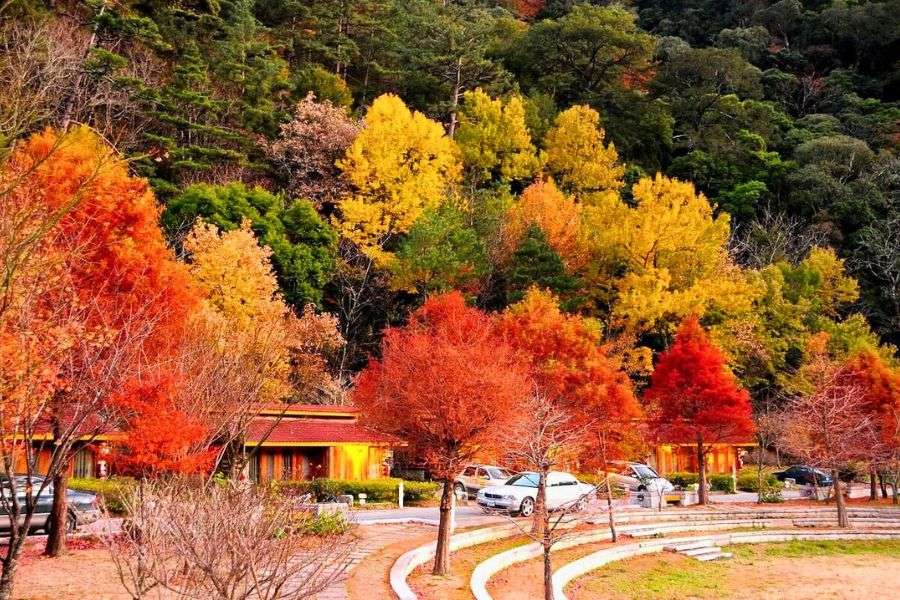
Central Taiwan generally has stronger high-mountain maple destinations such as Aowanda and Wuling Farm. Taipei and northern Taiwan offer easier day trips and are much more practical for travelers based in the capital or arriving through Keelung cruise port.