

Tai Tong red leaves are one of Hong Kong’s best-known seasonal sights. Hidden inside Tai Lam Country Park in the western New Territories, the Sweet Gum Woods attract visitors when green leaves begin turning yellow, orange and red during Hong Kong’s cooler months.
The experience is very different from seeing autumn colours in Japan or South Korea. Hong Kong’s foliage arrives much later, the exact timing changes every year, and reaching the famous Sweet Gum Woods involves considerably more walking than many first-time visitors expect.
At China Shore Excursions, we plan sightseeing around cruise schedules, realistic transfer times and the walking ability of each group. If you are visiting Hong Kong by ship, you can also browse our Hong Kong shore excursions or read our guide to autumn leaves in Hong Kong before deciding whether Tai Tong is the right seasonal stop for your port day.
This guide focuses specifically on Tai Tong Sweet Gum Woods, including the best time to visit, how the Red Leaf Index works, transportation, walking time, what the foliage actually looks like and whether Tai Tong is practical for cruise passengers.
What Is Tai Tong Sweet Gum Woods?
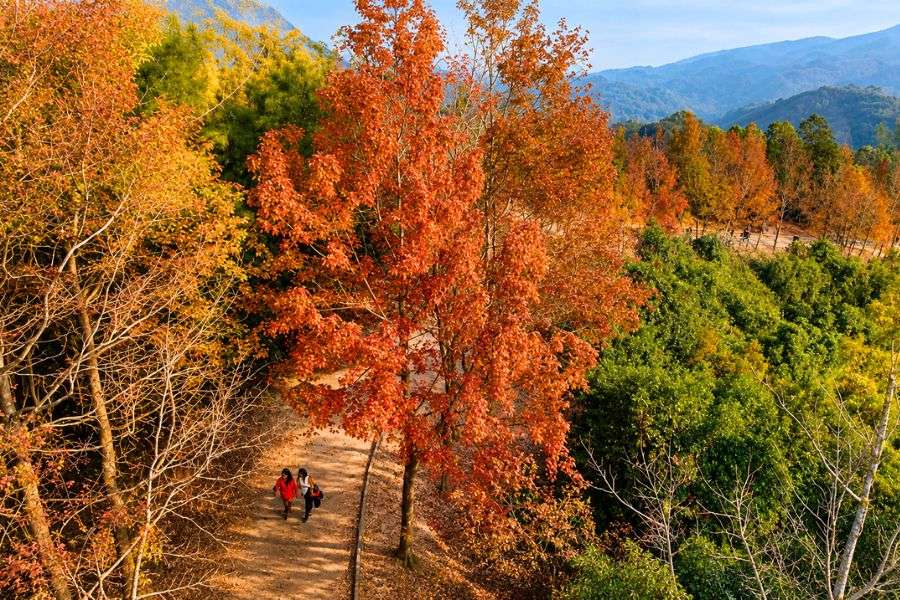
Tai Tong is an area on the edge of Tai Lam Country Park in Yuen Long, western New Territories. The surrounding country park contains hiking trails, reservoirs, forest roads and one of Hong Kong’s most photographed stands of Chinese sweet gum trees.
During much of the year, the trees simply form part of the green countryside. As temperatures fall later in the year, however, the foliage begins to change colour and the Sweet Gum Woods become a seasonal attraction.
The setting is relatively simple. Do not expect a formal Japanese-style garden or a long avenue of perfectly symmetrical maple trees. The appeal comes from warm-coloured sweet gum foliage growing along a forest road and contrasting with the surrounding evergreen landscape.
For many Hong Kong residents, Tai Tong has become closely associated with the arrival of the cooler season and is often the first place mentioned when people talk about seeing red leaves in Hong Kong.
Are Tai Tong Red Leaves Maple Leaves?
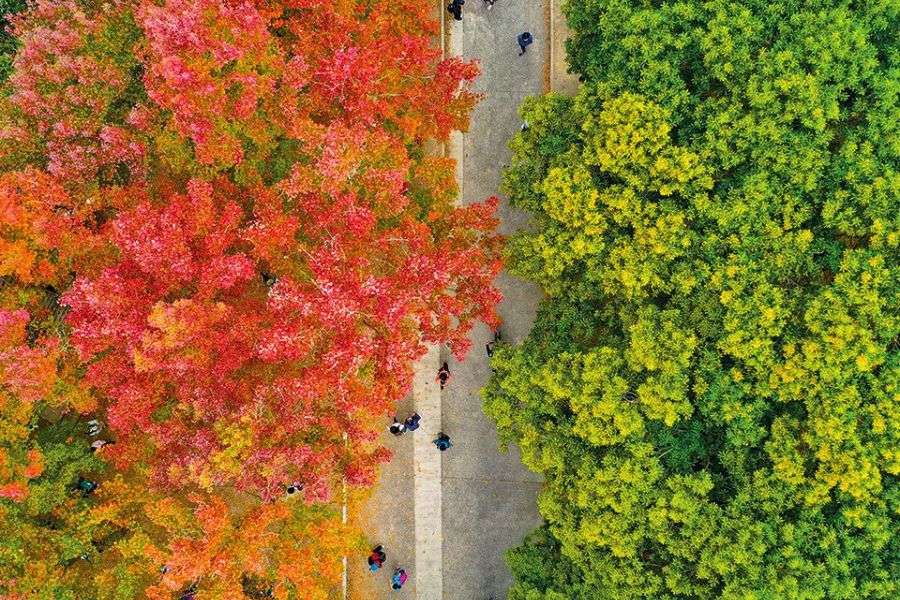
No. The famous trees at Tai Tong are primarily Chinese sweet gum, or Liquidambar formosana, rather than Japanese maple.
The distinction is useful because international visitors often see photographs of the red foliage and assume they are looking at maple trees. Sweet gum leaves can also develop striking autumn colours, but their timing and appearance are different.
The foliage does not change directly from green to bright red. Individual leaves and trees can move through several stages, producing a mixture of:
- green;
- yellow;
- gold;
- orange;
- red;
- reddish-brown.
This mixed colouring is part of the Tai Tong experience. Even during a good viewing period, not every tree will necessarily display the same shade at the same time.
When Is the Best Time to See Tai Tong Red Leaves?
The best time for Tai Tong red leaves is generally much later than the classic autumn foliage season in Japan, Korea or northern China.
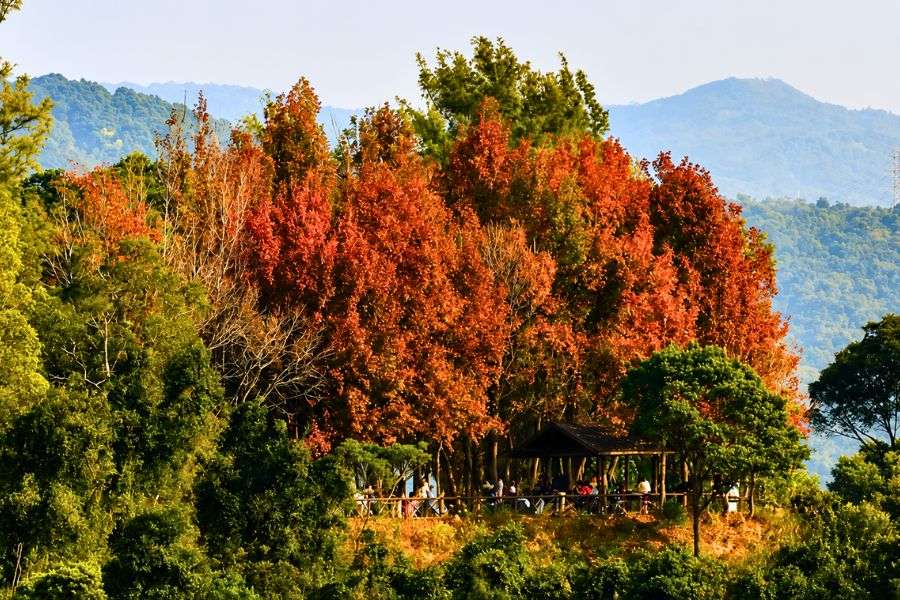
The official Hong Kong hiking information describes the sweet gum trees as developing their red display from late autumn through winter, normally around November and December. In practice, some of the strongest colour can develop during December and around the New Year period, with foliage sometimes remaining into January.
| Period | What to Expect at Tai Tong |
|---|---|
| October | Usually too early; most sweet gum foliage is likely to remain green |
| Early November | Some seasonal change may begin, but strong red foliage is not reliable |
| Late November | Yellow and warmer tones may become more noticeable depending on the weather |
| December | One of the strongest periods to watch for yellow, orange and red foliage |
| Late December to Early January | Often a rewarding viewing window when seasonal conditions are favourable |
| Later January | Leaves may become increasingly sparse as the season ends |
These dates are only a general guide. A cold and dry period can accelerate colour change, while warmer conditions may delay it.
If seeing red foliage is the main reason for visiting Tai Tong, do not choose your date solely because a photograph from the same week looked beautiful the previous year.
Why Does the Timing Change Every Year?
Leaf colour is influenced by temperature, sunlight and seasonal weather conditions.
As the weather becomes cooler and drier, chlorophyll in the leaves breaks down. Yellow pigments become more visible, while red pigments can develop under suitable conditions. That is why the same sweet gum trees can look mostly green one week, yellow or orange later and eventually develop deeper red tones.
Hong Kong’s subtropical climate makes this process particularly variable. A warm start to winter can delay the colour change, so fixed statements such as “Tai Tong peaks every December 15” should be treated cautiously.
The more useful approach is to combine the usual seasonal window with the latest official foliage condition.
What Is the Tai Tong Red Leaf Index?
Hong Kong’s Agriculture, Fisheries and Conservation Department monitors seasonal conditions at the Tai Lam Country Park Sweet Gum Woods using a Red Leaf Index.
This is one of the most useful tools for deciding whether Tai Tong is worth the trip.
| Red Leaf Index | What It Means for Visitors |
|---|---|
| Green | The foliage has not yet developed significant seasonal colour |
| Yellow | The colour-changing process has started |
| Turning Red | Red tones are developing and viewing is becoming more rewarding |
| Red | One of the strongest stages for visitors specifically seeking red foliage |
| Sparse Leaves | Many leaves have already fallen and the main viewing period is ending |
If Tai Tong is only one optional stop in a longer Hong Kong holiday, visiting during the Yellow stage can still be enjoyable.
For a cruise passenger sacrificing several hours of limited port time specifically to see the red foliage, however, the difference between Green, Turning Red and Red is much more important.
Should You Wait Until the Index Says Red?
Not necessarily. The answer depends on what you expect from the visit.
Yellow can provide attractive early autumn colours, while Turning Red may create one of the most varied scenes because green, yellow, orange and red can appear together.
If your priority is photography of vivid red foliage, the Red stage is more appealing. But it can also attract larger crowds, particularly on weekends and public holidays.
The key is to understand what each stage looks like rather than assuming anything short of bright red is a failed visit.
How to Get to Tai Tong Sweet Gum Woods
Most independent visitors first travel to the Yuen Long or Long Ping area and then continue toward Tai Tong.
A common public-transport approach is to take MTR Bus K66 from Long Ping Station or Yuen Long and get off around Tai Tong Shan Road. Red minibuses from Yuen Long may also serve the area.
From the Tai Tong Shan Road bus stop, the important part begins: visitors need to continue uphill on foot along Tai Tong Shan Road toward the Sweet Gum Woods.
Official seasonal guidance advises allowing approximately 60 minutes of uphill walking from the bus stop to the Sweet Gum Woods.
This is the detail that is most often underestimated when travelers first see photographs of Tai Tong online.
How Much Walking Is Required at Tai Tong?
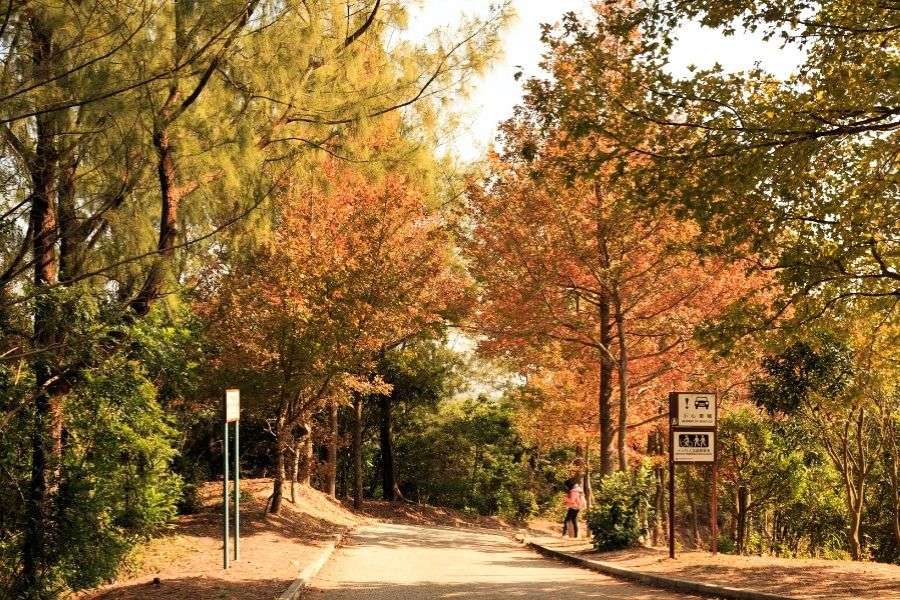
Tai Tong should not be described as a quick roadside foliage stop.
From the public-transport drop-off point at Tai Tong Shan Road, the official approach to the Sweet Gum Woods is approximately one hour uphill. You then need time to enjoy the foliage and walk back down again.
That means a basic visit can already involve roughly two hours of approach and return walking, before adding photography, rest stops or any additional trails.
The surface is generally more straightforward than a technical mountain hike, but the sustained uphill approach can still be tiring for travelers who are not used to walking.
For cruise passengers, this matters because walking time must be added to transportation from the cruise terminal and the return journey to the ship.
Is Tai Tong Nature Trail the Same as the Sweet Gum Woods?
Not exactly. Tai Tong contains several walking options, and travelers sometimes confuse the famous Sweet Gum Woods with the entire Tai Tong Nature Trail.
The official Tai Tong Nature Trail is approximately 3.2 kilometres long and is rated as a moderate trail, with an estimated walking duration of around two hours. The Sweet Gum Woods can be seen in the wider Tai Tong area, but visitors do not need to complete every available nature trail simply to see the seasonal foliage.
For a cruise-day visit, adding unnecessary trail distance can make the itinerary much less practical.
Can You Combine Tai Tong with Thousand Island Lake?
Yes, but this changes the outing from a foliage visit into a much more substantial hike.
The official Tai Tong to Wong Nai Tun Reservoir route combines Sweet Gum Woods with views toward the Tai Lam Chung Reservoir, often nicknamed Thousand Island Lake.
The full route is approximately 7.1 kilometres, takes around 3.5 hours and is classified as demanding.
For active hikers with plenty of time, the combination can be rewarding. For a typical cruise passenger trying to see Hong Kong and return to the ship comfortably, it should not be casually added simply because both places appear close on a map.
If your main purpose is the red leaves, concentrate on the Sweet Gum Woods. If your main purpose is hiking and landscape photography, then the longer route may make sense.
How Much Time Should You Allow for Tai Tong?
The total time depends on where you start and whether you are only visiting the Sweet Gum Woods or adding a longer country-park route.
Once you reach the Tai Tong Shan Road area, allow for:
- approximately one hour walking uphill toward the Sweet Gum Woods;
- time for foliage viewing, photography and rest;
- approximately one hour walking back down;
- additional waiting or transportation time.
For cruise passengers, you must then add the journey from your Hong Kong cruise terminal to the New Territories and the full return journey to the ship.
This is why Tai Tong should generally be treated as a major part of the port day, not a 30-minute stop squeezed between Victoria Peak and Central.
Can Cars Drive Directly to the Sweet Gum Woods?
Do not plan your visit on the assumption that a private vehicle can simply drive your group to the trees.
During the popular red-leaf season, Hong Kong authorities may introduce road closures and special traffic arrangements around Tai Tong, particularly on weekends and public holidays.
Official seasonal programmes in recent years have included restricted vehicle access on sections of Tai Tong Shan Road as well as additional public-transport arrangements for visitors.
The exact traffic measures can change each season, so your itinerary should be based on current arrangements rather than an old blog post or previous year’s experience.
What Is the Best Time of Day to Visit Tai Tong?
If you have flexibility, an earlier visit is usually the more practical choice, especially during the strongest red-leaf period.
Tai Tong becomes popular when the foliage reaches attractive colour stages, and weekends and public holidays can bring significantly more visitors.
For cruise passengers, starting earlier also creates a safer schedule. If the approach or photography takes longer than expected, you still have more time available for the return journey.
An early start does not guarantee empty trails, but it generally gives your day more flexibility than arriving late in the afternoon with a fixed all-aboard deadline.
Weekday or Weekend: Which Is Better?
A weekday is usually preferable when your cruise schedule allows it.
Peak red-leaf weekends can attract local visitors, photographers and hiking groups. Seasonal road controls may also be more extensive on Saturdays, Sundays and public holidays.
If your ship happens to call at Hong Kong on a busy weekend, that does not mean Tai Tong is impossible. It simply means crowd levels, walking time and transportation arrangements should be considered more carefully.
Is Tai Tong Worth Visiting for Cruise Passengers?
Yes, but only for certain cruise passengers.
Tai Tong is a good seasonal excursion if:
- your ship has a long port call;
- the current Red Leaf Index is favourable;
- autumn foliage is one of your main priorities;
- you enjoy walking;
- you have already seen Hong Kong’s classic attractions;
- you are comfortable dedicating a large part of the day to one nature area.
Tai Tong becomes less attractive if:
- you only have a short port call;
- this is your first visit to Hong Kong and you also want to see Victoria Peak, Central and Victoria Harbour;
- someone in the group has limited mobility;
- the Red Leaf Index still shows Green;
- poor weather makes the long outdoor walk less appealing.
Tai Tong for First-Time Hong Kong Visitors
If this is your first and perhaps only visit to Hong Kong, think carefully before making Tai Tong the centre of your port day.
The Sweet Gum Woods are seasonal and photogenic, but they are not one of the defining experiences that most first-time visitors associate with Hong Kong.
Victoria Peak, Victoria Harbour, Central and the city’s dense urban landscape usually provide a stronger introduction to the destination.
If your port call is long enough, Tai Tong may still work. But trying to combine it with every classic Hong Kong attraction can result in spending more time transferring and walking than actually enjoying the city.
For a realistic comparison of sightseeing time, see our one day in Hong Kong from cruise port guide.
Tai Tong for Returning Hong Kong Visitors
Tai Tong becomes much more compelling if you have already visited Hong Kong before.
Returning passengers may already have seen Victoria Peak, Central, Aberdeen and the Tsim Sha Tsui waterfront. A seasonal trip into the New Territories can therefore provide a genuinely different experience rather than repeating the same city highlights.
If the Red Leaf Index shows good colour and everyone in the group is comfortable walking, Tai Tong can be one of the more interesting December or early-winter alternatives for a repeat Hong Kong call.
Is Tai Tong Suitable for Seniors?
Tai Tong is not the easiest foliage location for senior cruise passengers.
Age itself is not the deciding factor. The more important issue is walking ability.
A fit older traveler who regularly walks several kilometres may enjoy the visit. Someone who prefers short, level walks may find the sustained uphill approach uncomfortable.
Before including Tai Tong, consider whether everyone in the group can comfortably manage:
- approximately one hour of uphill walking;
- the return walk downhill;
- extended time outdoors;
- limited opportunities to shorten the approach once the walk has started;
- possible crowds during peak foliage periods.
If the answer is uncertain, an easier Hong Kong foliage location may provide a better port-day experience.
Tai Tong with Limited Mobility
For guests with significant mobility limitations, Tai Tong Sweet Gum Woods will generally not be our first recommendation.
The problem is not simply the sightseeing area itself. The long approach means a private vehicle cannot necessarily remove the main walking requirement, particularly when seasonal road restrictions are in force.
If seeing autumn colours is important, consider an urban garden or park that can be incorporated into a more vehicle-based Hong Kong itinerary.
Our broader guide to Hong Kong autumn leaves compares several alternatives with different walking levels.
Tai Tong from Kai Tak Cruise Terminal
Passengers arriving at Kai Tak Cruise Terminal start on the Kowloon side of Hong Kong, while Tai Tong lies much farther west in the New Territories.
This makes Tai Tong a destination that should be planned deliberately rather than added spontaneously during a normal city highlights tour.
With a long port call and favourable foliage conditions, a dedicated Tai Tong visit can work. With a shorter call, the combination of transfers and walking may use too much of your available time.
If this is your first Hong Kong visit, compare the seasonal excursion against what you would otherwise see in Central, Victoria Peak and Victoria Harbour before making the decision.
Tai Tong from Ocean Terminal
Ocean Terminal places passengers directly in Tsim Sha Tsui, but Tai Tong is still well outside the immediate city-centre sightseeing area.
The advantage of Ocean Terminal is that the harbour and Tsim Sha Tsui require little additional travel. The disadvantage of a Tai Tong-focused excursion is that you leave this convenient central location and dedicate a substantial part of your available time to reaching the New Territories.
For returning visitors this may be worthwhile. For first-time visitors on a short call, remaining closer to central Hong Kong usually produces a more varied introduction.
If you are not sure where your ship docks, check our Hong Kong Cruise Port Guide before planning the day.
What Will Tai Tong Actually Look Like?
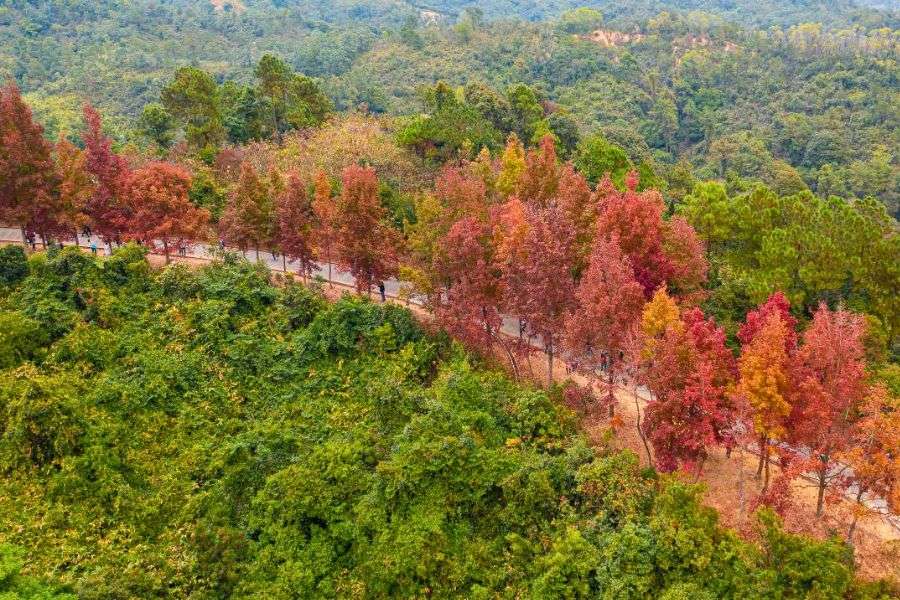
Manage expectations before you go. Tai Tong does not normally become an uninterrupted forest of bright red trees. Sweet gum grows among Hong Kong’s wider subtropical vegetation, much of which remains green through winter.
The scene is therefore more likely to include red, orange and yellow sweet gum framed by green vegetation.
During the Turning Red stage, individual trees may also colour at different speeds. This creates a mixed landscape rather than a uniform wall of red.
For many photographers, that variety is part of the appeal.
Photography Tips for Tai Tong Red Leaves
You do not need professional equipment to photograph the Sweet Gum Woods well, but a few practical choices can improve the result.
- Photograph the colour contrast. Red and yellow leaves stand out particularly well against Hong Kong’s evergreen background.
- Look upward. Shooting through the sweet gum canopy can emphasize leaf shape and colour.
- Use the forest road. The pathway can create useful leading lines through the foliage.
- Include different colour stages. Green, yellow, orange and red together often tell the seasonal story better than trying to frame only red leaves.
- Be patient around crowds. During peak periods, waiting a few moments can produce a cleaner composition.
- Stay on permitted paths. Do not step into vegetation or climb trees simply to create a photograph.
What to Wear and Bring
Tai Tong is an outdoor walking experience, so prepare differently from a normal Hong Kong city sightseeing day.
- Wear comfortable walking shoes with good grip.
- Bring drinking water.
- Carry a light layer for cooler winter weather.
- Use sun protection on clear days.
- Check the forecast before leaving the city.
- Carry only what you are comfortable walking uphill with.
- Bring any personal medication you may need during an extended outdoor excursion.
There are no rubbish bins along parts of the route to the Sweet Gum Woods, so visitors should take their rubbish away with them.
Should You Visit If the Red Leaf Index Is Still Green?
If you are already staying near Yuen Long and enjoy country-park walking, the answer may still be yes.
If you are a cruise passenger traveling across Hong Kong specifically for colourful foliage, we would normally reconsider.
A Green index means the seasonal display you are expecting has not yet developed. With limited time ashore, another Hong Kong experience may provide much better value for the day.
You can then choose Victoria Peak, local neighborhoods, Victoria Harbour or one of Hong Kong’s more accessible seasonal parks instead.
What If the Leaves Are Already Sparse?
Sparse Leaves indicates the strongest foliage period is ending and many leaves have already fallen.
Tai Tong can still be pleasant as a country-park walk, but the experience may no longer justify a dedicated journey if red foliage is your main objective.
This is another reason to check the current seasonal update shortly before your arrival rather than assuming early January or another fixed date will always provide peak conditions.
Can Tai Tong Be Combined with a Hong Kong City Tour?
It is possible with a sufficiently long port call, but this should be done selectively.
Avoid building an itinerary such as:
Tai Tong → Victoria Peak → Aberdeen → Stanley → Central → multiple Kowloon markets → cruise port
Even if the route looks technically possible on a map, it leaves too little room for traffic, walking, photography and a comfortable return to the ship.
A better approach is to decide which part of the day matters most.
If foliage is the priority, make Tai Tong the main excursion and add only one or two practical city experiences if time remains. If Hong Kong sightseeing is the priority, choose an easier autumn-colour stop closer to the city instead.
When Should Cruise Passengers Skip Tai Tong?
We would normally advise against a Tai Tong-focused port day when:
- your usable time ashore is short;
- the Red Leaf Index is Green or Sparse Leaves;
- someone in the group cannot comfortably manage the walk;
- heavy rain or poor weather makes the outdoor route unsuitable;
- you are a first-time visitor who would regret missing Hong Kong’s main highlights;
- seasonal traffic arrangements make the schedule too tight for your ship’s all-aboard time.
Choosing not to visit Tai Tong does not mean missing Hong Kong’s entire autumn season. There are easier places to see yellow, orange and red foliage closer to the city’s main sightseeing areas.
Plan a Tai Tong Red Leaves Visit from Your Cruise Ship
Tai Tong is one of Hong Kong’s most distinctive cooler-season landscapes, but it works best when approached as a real outdoor excursion rather than a quick photo stop.
The most important factors are the current Red Leaf Index, your available port time and your group’s walking ability.
If the leaves are turning red, your ship has a long call and everyone is comfortable with the uphill approach, Tai Tong can provide a memorable alternative to Hong Kong’s usual skyline sightseeing.
If this is your first visit, your schedule is short or walking is a concern, an easier seasonal location combined with Hong Kong’s classic sights may be a better choice.
Browse our Hong Kong shore excursions or request a tailor-made shore trip if you would like us to assess whether Tai Tong can fit realistically into your ship’s Hong Kong port call.
Frequently Asked Questions
When do Tai Tong red leaves usually appear?
The colour change generally develops from late autumn into winter. November can bring early changes, while December and the period around the New Year often provide stronger yellow, orange and red foliage. Exact timing varies each year.
What trees create the red leaves at Tai Tong?
The famous foliage is mainly Chinese sweet gum, or Liquidambar formosana. These are not Japanese maple trees. Sweet gum foliage can develop yellow, orange and red shades as temperatures fall.
How do I know if Tai Tong leaves are red?
Check the latest official Red Leaf Index for the Tai Lam Country Park Sweet Gum Woods. The index uses Green, Yellow, Turning Red, Red and Sparse Leaves to describe current foliage conditions.
How long is the walk to Tai Tong Sweet Gum Woods?
Official seasonal guidance advises allowing about 60 minutes of uphill walking from the Tai Tong Shan Road public-transport stop to the Sweet Gum Woods. You also need to allow time for the return walk.
Can a taxi or private car drive directly to Tai Tong Sweet Gum Woods?
Do not assume that vehicles can reach the Sweet Gum Woods directly. Seasonal road closures and traffic controls may restrict vehicle access, particularly during busy weekends and public holidays.
Is Tai Tong an easy hike?
The approach to the Sweet Gum Woods is not a technical mountain hike, but the sustained uphill walking can be tiring. Visitors should be comfortable walking for an extended period before choosing Tai Tong.
Is Tai Tong suitable for senior cruise passengers?
It depends on walking ability rather than age alone. Active seniors may enjoy the visit, but travelers who prefer short or level walks may find the long uphill approach unsuitable.
Can I visit Tai Tong during a Hong Kong cruise stop?
Yes, particularly if you have a long port call and the Red Leaf Index is favourable. However, transportation and walking make Tai Tong much less practical for short port calls.
Can I combine Tai Tong with Victoria Peak?
It may be possible during a long port call, but avoid trying to combine Tai Tong with a full list of Hong Kong Island and Kowloon attractions. Tai Tong should be treated as a major part of the day’s itinerary.
Is December the best month for Tai Tong red leaves?
December is often one of the stronger periods, but there is no guaranteed fixed peak date. Weather can delay or accelerate the colour change, so the latest Red Leaf Index is more useful than choosing a date based only on the calendar.
Is Tai Tong worth visiting if the Red Leaf Index is Green?
It can still be pleasant for hiking, but cruise passengers traveling specifically for autumn colours may prefer another activity until the foliage has progressed beyond the Green stage.
Can I visit Thousand Island Lake and Tai Tong Sweet Gum Woods together?
Yes, but the longer official route combining Sweet Gum Woods with the reservoir viewpoint is approximately 7.1 kilometres and takes around 3.5 hours. It is more suitable for active hikers than for a typical short cruise excursion.