
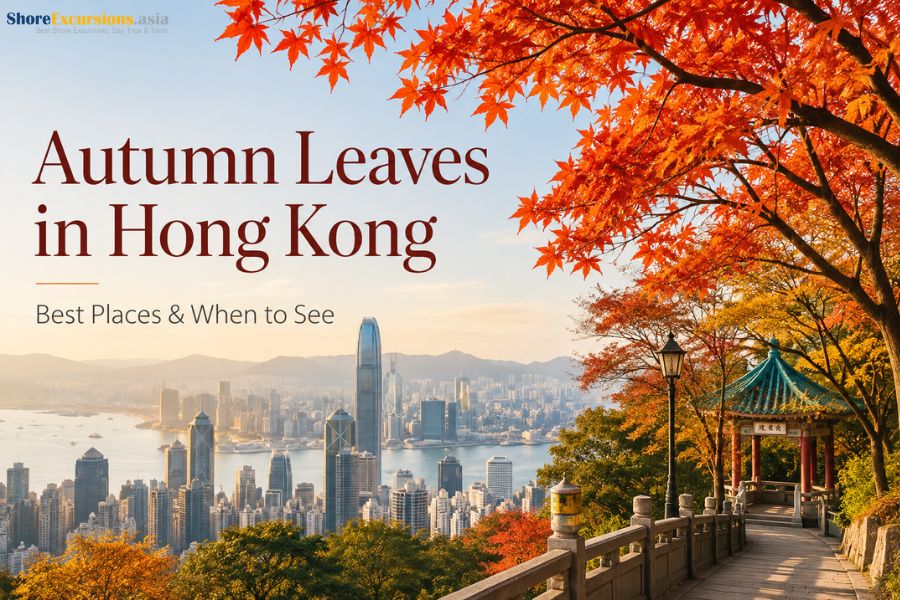
Autumn leaves in Hong Kong may come as a surprise to travelers who associate the city mainly with skyscrapers, Victoria Harbour and subtropical greenery. Hong Kong does have seasonal foliage, with sweet gum, bald cypress and other deciduous trees turning shades of yellow, orange, red and reddish-brown as temperatures fall.
The timing, however, is quite different from Japan or South Korea. Hong Kong’s autumn colours generally arrive later, often developing from late autumn into winter rather than peaking in October. That makes foliage viewing particularly interesting for cruise passengers visiting Hong Kong toward the end of the year.
At China Shore Excursions, we plan sightseeing around cruise schedules rather than treating every visitor like a hotel guest with unlimited time. If Hong Kong is one of your ports of call, our Hong Kong shore excursions can also be adjusted to include seasonal scenery when the timing and location make sense.
This guide explains when to see autumn leaves in Hong Kong, where the best foliage spots are, what colours to expect and which locations are realistic during a cruise port day.
Does Hong Kong Really Have Autumn Leaves?
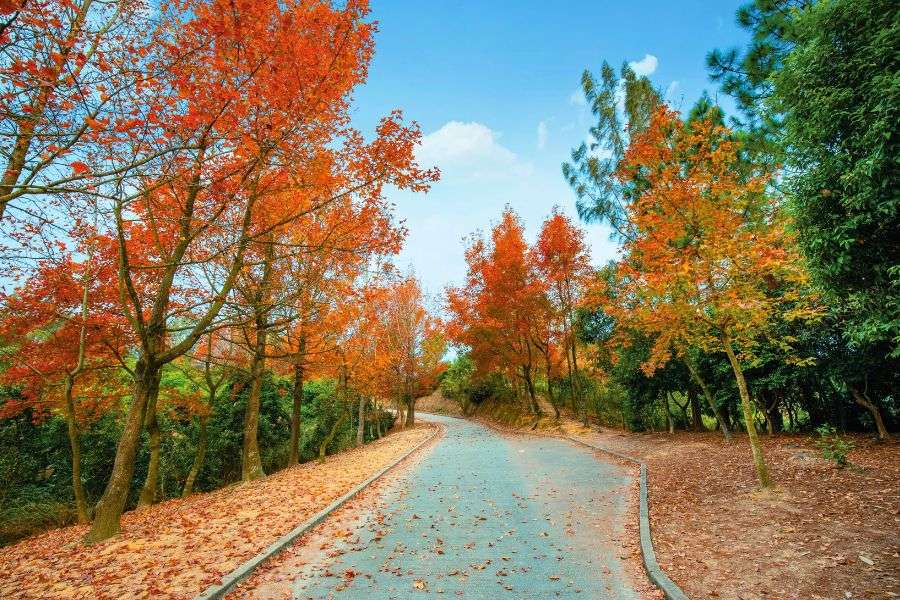
Yes. Hong Kong has a subtropical climate, but several tree species still show noticeable seasonal colour changes when cooler and drier conditions arrive.
One of the most important is Chinese sweet gum, or Liquidambar formosana, a native deciduous tree found in Hong Kong. Its three-lobed green leaves can first turn yellow before developing orange and red tones as the season progresses.
Bald cypress is another tree associated with Hong Kong’s cooler-season scenery. Its fine foliage can develop orange, copper and reddish-brown shades before falling.
This means Hong Kong’s foliage should not be imagined as a landscape covered entirely in bright red maple leaves. What you are more likely to see is a mixture of yellow, gold, orange, red and brown against Hong Kong’s year-round green vegetation.
When Is the Best Time to See Autumn Leaves in Hong Kong?
The most important thing to understand is that Hong Kong’s autumn foliage usually arrives later than in many famous East Asian leaf-viewing destinations.
October can still feel very green. Colour changes become more likely as temperatures fall in November and December, while some of the most noticeable red and orange foliage may appear around late December or even continue into January.
| Period | What You May See |
|---|---|
| October | Mostly green foliage in many areas; generally too early for reliable autumn colours |
| November | Early colour changes may begin, especially as nights become cooler |
| December | Better chance of yellow, orange and red foliage at well-known seasonal spots |
| Late December to Early January | Often one of the most rewarding periods, particularly for sweet gum |
| January | Colour may remain in some locations, although leaves can become sparse as the season progresses |
These periods should be treated as a guide rather than a guarantee. The exact timing changes from year to year because foliage colour depends on temperature, sunlight and other weather conditions.
If seeing autumn leaves is one of the main reasons for your visit, check the latest seasonal condition shortly before your arrival instead of choosing a location only from photographs taken in previous years.
Are Hong Kong’s Autumn Leaves Red or Yellow?
Both, and this is one reason the term Hong Kong autumn colours can be more accurate than simply calling them red leaves.
Sweet gum foliage can move through several stages. Leaves may begin green, develop yellow or golden tones and later become orange or red before falling. Different trees may also change at different speeds, so a single woodland can contain several colours at the same time.
Bald cypress creates a different effect, with fine foliage changing towards yellow, copper, orange and reddish-brown.
Hong Kong therefore does have yellow autumn leaves, although it is not generally known for vast yellow ginkgo avenues in the way some Japanese, Korean or mainland Chinese destinations are. The characteristic Hong Kong scene is more often a mixed palette of warm colours surrounded by subtropical greenery.
Best Places to See Autumn Leaves in Hong Kong
The best foliage location depends on more than which place has the most colourful photographs. Distance, walking requirements and the amount of time available are particularly important for cruise passengers.
1. Tai Tong Sweet Gum Woods
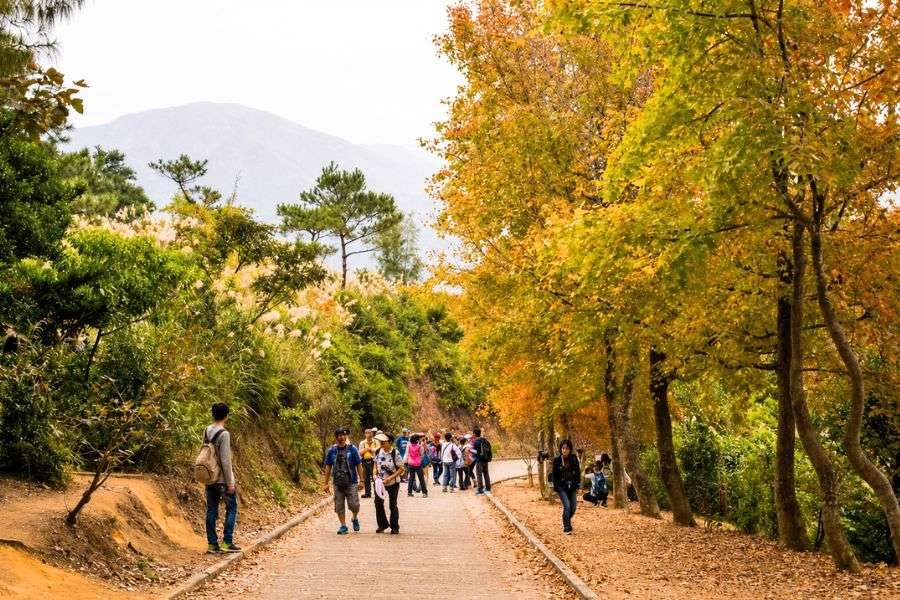
Tai Tong in Tai Lam Country Park is the name most closely associated with autumn leaves in Hong Kong. Rows of Chinese sweet gum trees create yellow, orange and red foliage during the cooler part of the year, making the area especially popular with photographers and local visitors.
If your main purpose is foliage viewing and you have enough time, Tai Tong offers one of Hong Kong’s strongest seasonal experiences.
There is an important practical consideration, however. Tai Tong is in Yuen Long in the New Territories rather than central Hong Kong, and reaching the famous Sweet Gum Woods involves a substantial walk. Seasonal traffic arrangements and road restrictions can also affect how close vehicles can approach.
For this reason, Tai Tong is not automatically the best choice for a short cruise call, senior traveler or anyone who prefers very limited walking.
Best for: Active travelers, photographers, returning visitors and those making autumn foliage the main focus of the day.
Less suitable for: Very short port calls, limited mobility or a first-time Hong Kong itinerary that also tries to include Victoria Peak, Central and several other districts.
2. Hong Kong Zoological and Botanical Gardens
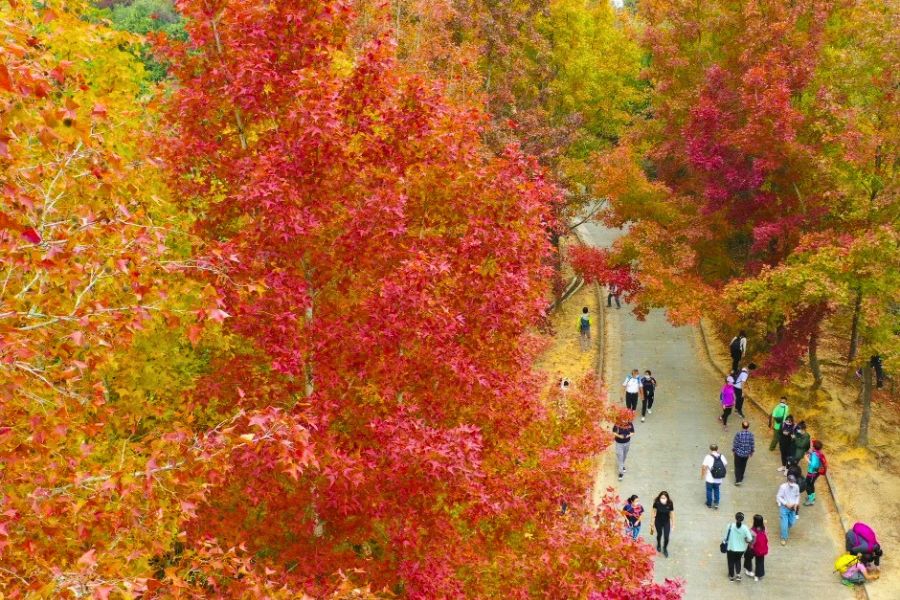
For cruise passengers, the Hong Kong Zoological and Botanical Gardens may be one of the most practical places to add seasonal foliage without turning the entire day into a countryside excursion.
The gardens are located in Central on Hong Kong Island and contain both sweet gum and bald cypress that display autumn foliage. This makes the location much easier to combine with a conventional Hong Kong sightseeing day.
For example, a first-time itinerary might include Victoria Peak, Central, the gardens and Victoria Harbour without requiring a long journey into the New Territories solely for foliage viewing.
The setting is also more suitable for travelers who want a gentle seasonal stop rather than a long country-park hike.
Best for: First-time visitors, cruise passengers, shorter port calls and travelers who want autumn colours combined with classic Hong Kong sightseeing.
3. Lau Shui Heung Reservoir
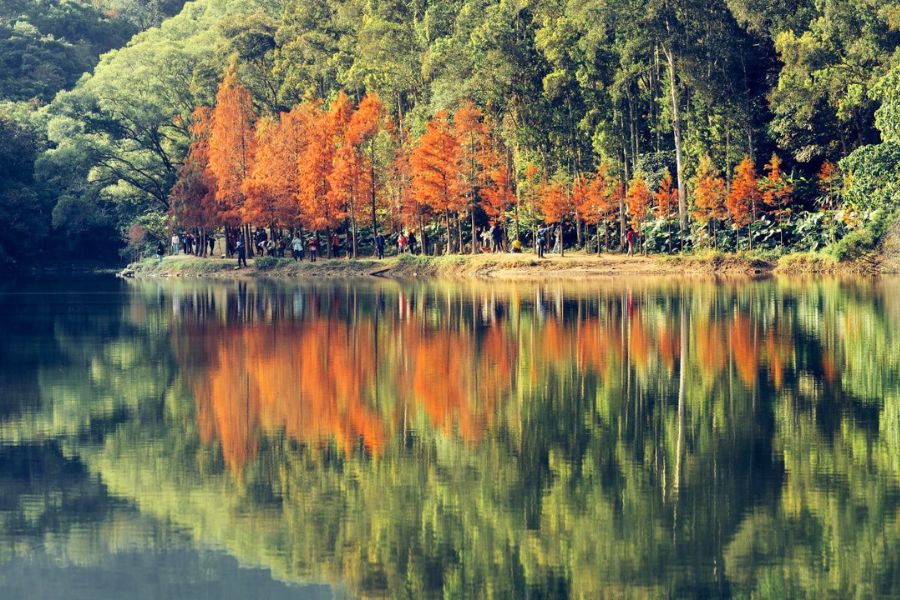
Lau Shui Heung Reservoir in the New Territories offers one of Hong Kong’s most photogenic combinations of autumn foliage and water.
When seasonal colours develop, orange and reddish trees can be reflected in the calm reservoir, creating a completely different atmosphere from the urban skyline normally associated with Hong Kong.
This is a stronger option for travelers interested in nature and photography than for passengers simply trying to add a quick foliage stop to a city tour.
The surrounding area is associated with woodland walking and hiking, so visitors should consider both walking ability and travel time before choosing it during a cruise call.
Best for: Nature lovers, photographers, active travelers and returning visitors.
Less suitable for: Short cruise calls or travelers whose priority is seeing Hong Kong’s classic city highlights.
4. Tsing Yi Park
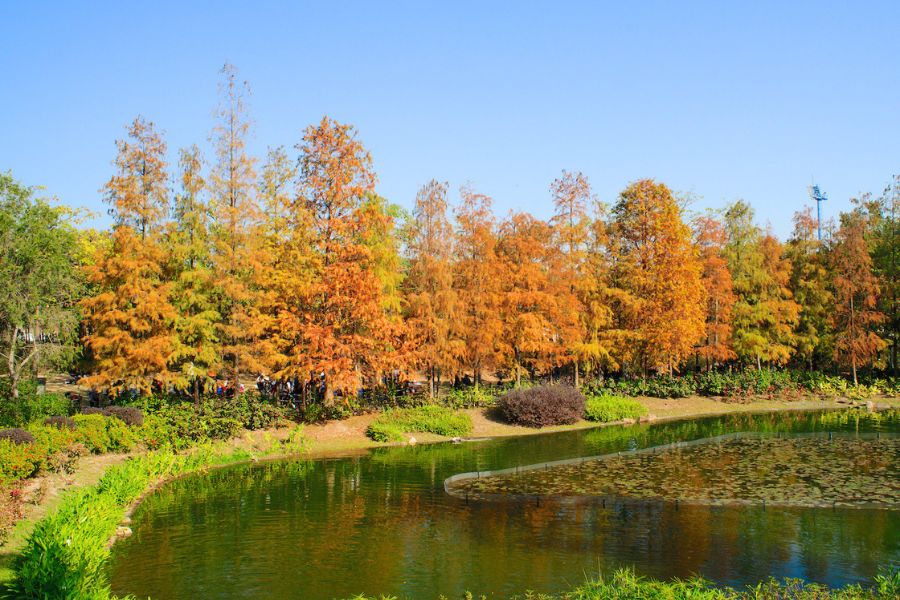
Tsing Yi Park provides another style of Hong Kong fall foliage. Trees around the ornamental lake can change from yellow towards darker reddish-brown shades as the weather cools.
Unlike the more remote country-park foliage locations, Tsing Yi Park offers an urban park setting. The combination of water, seasonal trees and landscaped paths can be attractive for travelers who want autumn scenery without committing to a long woodland hike.
It is not as iconic as Tai Tong for red sweet gum, but that can actually be an advantage for some travelers. The experience is more relaxed and the foliage includes attractive yellow and copper tones rather than relying entirely on vivid red leaves.
Best for: Easier walking, relaxed photography and travelers wanting an urban alternative to Tai Tong.
5. Pineapple Dam Nature Trail and Shing Mun Reservoir
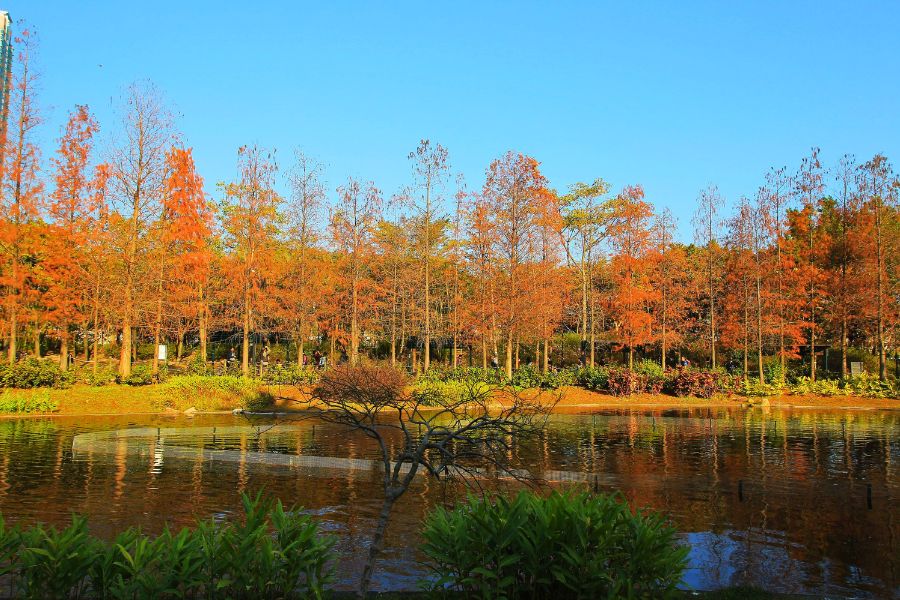
The Pineapple Dam Nature Trail beside Shing Mun Reservoir combines woodland scenery, water and seasonal colour.
During the cooler months, foliage around the reservoir can develop warm red and brown tones, while paperbark trees and the surrounding forest create a more natural setting than Hong Kong’s city parks.
This is another destination where the experience is about the landscape as a whole rather than one perfectly arranged avenue of red trees.
The area is better suited to visitors comfortable with outdoor walking. Wildlife, including monkeys, can also be encountered around Shing Mun, so visitors should avoid feeding or approaching animals.
Best for: Outdoor travelers, nature photography and visitors who want a countryside experience.
6. Jordan Valley Park
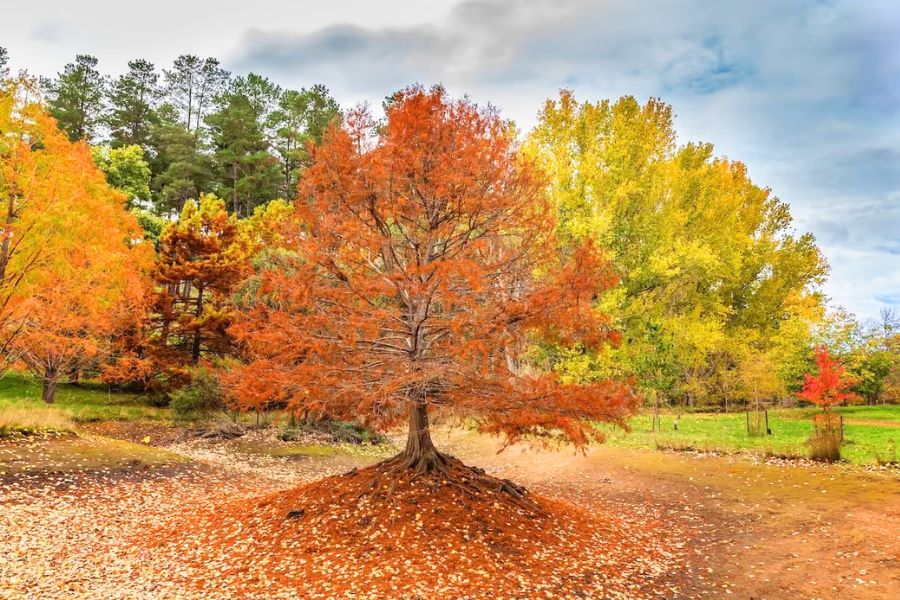
Jordan Valley Park provides a useful urban alternative, particularly for travelers who do not want to spend most of their port day travelling into the distant New Territories.
The large landscaped park includes trees that develop warmer seasonal colours as temperatures fall, creating patches of red and autumn-toned foliage around its lawns and walking areas.
It does not offer the dense Sweet Gum Wood experience of Tai Tong, but for some cruise passengers that is not necessary. A convenient seasonal stop that fits naturally into the day’s route can be more valuable than a famous foliage location requiring several hours of travel and walking.
Best for: A lighter seasonal stop, easier-paced sightseeing and passengers arriving on the Kowloon side.
Which Autumn Foliage Spot Is Best for Cruise Passengers?
The answer is not simply Tai Tong. The most famous location and the most practical cruise excursion are not always the same thing.
| Location | Foliage Experience | Walking | Cruise-Day Fit |
|---|---|---|---|
| Tai Tong | Strong sweet gum colours | Considerable | Best with a long call and active guests |
| Hong Kong Zoological and Botanical Gardens | Sweet gum and bald cypress | Manageable for many visitors | Excellent for combining with city highlights |
| Lau Shui Heung Reservoir | Foliage reflected in reservoir scenery | Moderate outdoor walking | Better for a nature-focused full day |
| Tsing Yi Park | Yellow to reddish-brown foliage | Generally easier | Good urban alternative |
| Shing Mun Reservoir | Woodland autumn colours | Outdoor trail walking | Better for active returning visitors |
| Jordan Valley Park | Urban seasonal foliage | Relatively easy to adapt | Useful for a lighter seasonal stop |
For most first-time cruise passengers, we would not recommend giving up all of Hong Kong’s signature experiences solely to visit the most distant foliage spot.
Instead, consider combining an accessible seasonal location with Victoria Peak, Central, Victoria Harbour or another part of the city. Returning visitors who have already seen Hong Kong’s famous highlights have more reason to dedicate a full port day to Tai Tong or a reservoir area.
Is Tai Tong Worth Visiting During a Cruise Stop?
Tai Tong can absolutely be worth visiting, but only for the right traveler and cruise schedule.
The photographs can make the Sweet Gum Woods look like an easy roadside stop. In reality, visitors should be prepared for the approach to the woods, including uphill walking and seasonal transportation restrictions.
This makes Tai Tong a poor choice if you have only a few hours ashore and still want to see Victoria Peak, Central and Victoria Harbour.
Tai Tong makes more sense if:
- your ship has a long Hong Kong port call;
- autumn foliage is one of your main priorities;
- you are comfortable with extended walking;
- you have already visited Hong Kong’s classic sights;
- the current Red Leaf condition is good enough to justify the journey.
If the foliage is still mostly green, a long journey to Tai Tong may not be the best use of limited cruise time. This is why checking the seasonal condition before finalising the itinerary is particularly important.
Best Autumn Leaves from Kai Tak Cruise Terminal
Passengers arriving at Kai Tak Cruise Terminal should consider travel time carefully when planning a foliage excursion.
If this is your first visit and you have a typical six to eight-hour sightseeing window, it can be more practical to combine Hong Kong’s city highlights with an accessible autumn-colour stop rather than travelling directly to a remote country park.
Jordan Valley Park is on the Kowloon side and may work as a lighter seasonal addition when foliage conditions are worthwhile. Another option is to travel to Hong Kong Island and include the Hong Kong Zoological and Botanical Gardens as part of a broader Central and Victoria Peak itinerary.
Tai Tong becomes more realistic with a longer call, but the walking requirement still needs to suit everyone in the group.
Best Autumn Leaves from Ocean Terminal
Ocean Terminal starts you directly in Tsim Sha Tsui, making it easy to combine Victoria Harbour with sightseeing on Hong Kong Island.
For first-time passengers, a practical seasonal itinerary can cross towards Central, visit the Hong Kong Zoological and Botanical Gardens, continue with Victoria Peak or nearby city sights and then return to Tsim Sha Tsui.
This gives you a taste of Hong Kong’s autumn colours without using most of the port day travelling to and from a remote foliage destination.
If you have already visited Central and Victoria Peak on an earlier cruise, a longer nature-focused trip into the New Territories becomes much more attractive.
If you are unsure which terminal your ship uses, see our Hong Kong Cruise Port Guide before planning your route.
Autumn Leaves in Hong Kong for Seniors and Limited Walking
Autumn foliage can certainly be included in a senior-friendly Hong Kong port day, but location choice matters.
Tai Tong and some reservoir routes involve significantly more walking than many cruise passengers expect. A place may appear easy in photographs even though reaching the best viewing area requires an extended uphill or woodland walk.
For guests who prefer limited walking, consider:
- choosing an urban park or garden instead of a remote country-park trail;
- combining one foliage stop with scenic vehicle-based sightseeing;
- avoiding an itinerary built around several hiking locations;
- allowing more time for rest and vehicle boarding;
- checking the actual walking distance before confirming the day;
- telling your guide about mobility requirements in advance.
The Hong Kong Zoological and Botanical Gardens or another accessible urban foliage location can often provide a more comfortable experience than travelling to the most famous red-leaf destination simply because it appears first in online lists.
How to Check Hong Kong’s Autumn Leaf Conditions
Hong Kong’s foliage timing changes from year to year, so recent conditions are more useful than a fixed calendar date.
The Agriculture, Fisheries and Conservation Department publishes seasonal information for the Tai Tong Sweet Gum Woods and uses a Red Leaf Index to describe foliage conditions.
The stages include:
- Green – the leaves have not yet developed significant autumn colour;
- Yellow – seasonal colour change is beginning;
- Turning Red – red tones are developing;
- Red – one of the stronger periods for red foliage viewing;
- Sparse Leaves – many leaves have already fallen.
If Tai Tong is your main destination, check the latest condition shortly before your visit. A photograph from the same date in a previous year is not a reliable indication of what you will see this year.
Can You See Autumn Leaves During a 6-Hour Hong Kong Port Day?
Yes, but keep the itinerary realistic.
With approximately six usable hours ashore, first-time visitors will generally get more from combining one accessible seasonal foliage location with two or three Hong Kong highlights than using most of the day for a dedicated trip to the New Territories.
A possible city-focused plan could include:
- Cruise port pickup
- Victoria Peak
- Central
- Hong Kong Zoological and Botanical Gardens if foliage conditions are worthwhile
- Victoria Harbour
- Return to the ship
The exact order should depend on your cruise terminal, traffic and the day’s visibility.
What About an 8 to 10-Hour Port Day?
With eight to ten usable hours, you have more freedom to make autumn foliage a meaningful part of the itinerary.
First-time visitors can still combine a city foliage stop with Victoria Peak, local neighborhoods, a Cantonese lunch and Victoria Harbour.
Returning visitors may instead choose a nature-focused day built around Tai Tong, Lau Shui Heung or another New Territories destination, provided the walking level suits the group.
See our one day in Hong Kong from cruise port guide for more ideas on what can realistically fit into different port-call lengths.
Is Autumn Foliage Worth Prioritizing on a First Visit to Hong Kong?
It depends on the foliage condition and what you most want to experience.
If this is your first and perhaps only visit to Hong Kong, Victoria Peak, Victoria Harbour and the city’s distinctive urban culture will usually be more important than travelling several hours solely for autumn leaves.
That does not mean you need to ignore the season. An accessible foliage stop can add something special to a classic sightseeing itinerary without replacing the experiences that make Hong Kong unique.
For a returning visitor, the calculation is different. If you have already visited the Peak, Central and the major harbour sights, a seasonal nature excursion can reveal a side of Hong Kong that many cruise travelers never see.
What to Expect from Hong Kong Fall Foliage
Travelers comparing Hong Kong with Japan, Korea or northern China should keep expectations realistic.
Hong Kong’s subtropical vegetation means you are unlikely to see entire mountains covered uniformly in red and yellow. Evergreen vegetation remains prominent throughout the cooler months.
The appeal comes from contrast: red sweet gum against green woodland, copper cypress beside reflective water, or yellow and orange leaves appearing inside a dense subtropical city.
This is a different autumn landscape, not an inferior one. Understanding that difference helps visitors choose the right location and timing.
Practical Tips for Seeing Autumn Leaves in Hong Kong
- Check current foliage conditions. The calendar alone cannot guarantee red leaves.
- Do not assume October is peak season. Hong Kong’s colour change is generally later than Japan or Korea.
- Allow for walking. Famous nature locations may require much more walking than urban parks.
- Visit with realistic expectations. Yellow, orange, red and green may all appear together.
- Consider weekday visits for popular foliage areas. Well-known seasonal spots can become busy when the leaves are at their best.
- Wear comfortable shoes. This is especially important for Tai Tong and reservoir areas.
- Keep your cruise schedule in mind. A beautiful foliage spot is not worth risking a rushed return to port.
- Stay flexible. If foliage conditions are poor, Hong Kong still offers excellent city, harbour and cultural alternatives.
Plan a Hong Kong Autumn Shore Excursion
Autumn leaves can add a seasonal dimension to a Hong Kong cruise call, but the best location depends on your date, ship schedule and walking preference.
For first-time visitors, an urban foliage stop can be combined with Hong Kong’s classic highlights. For returning travelers or dedicated photographers, Tai Tong or one of the New Territories reservoir areas can become the main focus of a longer day ashore.
The most important point is not to build the itinerary around photographs taken in another year. Check the current leaf condition first, then decide whether the foliage is worth the additional travel time.
Browse our Hong Kong shore excursions or request a tailor-made shore trip if you would like to combine seasonal scenery with a Hong Kong itinerary planned around your ship’s arrival and all-aboard time.
Frequently Asked Questions
Does Hong Kong have autumn leaves?
Yes. Sweet gum, bald cypress and several other trees in Hong Kong develop seasonal colours as temperatures fall. Depending on the species and conditions, leaves can turn yellow, orange, red or reddish-brown during late autumn and winter.
What month is best for autumn leaves in Hong Kong?
December is generally a stronger period than October for Hong Kong foliage, with colour sometimes continuing into early January. However, the exact timing varies each year, so current foliage conditions should be checked before visiting.
Can I see autumn leaves in Hong Kong in November?
Possibly. Some trees may begin changing colour in November, but many well-known Hong Kong foliage locations develop stronger yellow, orange and red tones later in the season.
Where is the most famous place to see red leaves in Hong Kong?
Tai Tong Sweet Gum Woods in Tai Lam Country Park is one of Hong Kong’s best-known red-leaf locations. Its sweet gum trees develop warm seasonal colours during the cooler months.
Are the red leaves at Tai Tong maple leaves?
The famous foliage at Tai Tong is primarily associated with Chinese sweet gum rather than Japanese maple. Sweet gum leaves can develop yellow, orange and red colours as the season progresses.
Is Tai Tong suitable for senior cruise passengers?
It depends on mobility. Reaching the best-known Sweet Gum Woods involves a substantial uphill walk, so Tai Tong may not be suitable for travelers who prefer minimal walking. An urban garden or park may be a more comfortable alternative.
What is the easiest place to see autumn leaves during a Hong Kong cruise stop?
For many first-time cruise passengers, the Hong Kong Zoological and Botanical Gardens is one of the easiest options because it can be combined with Central, Victoria Peak and other Hong Kong Island sightseeing rather than requiring a dedicated trip deep into the New Territories.
Does Hong Kong have yellow autumn leaves?
Yes. Sweet gum can turn yellow before progressing towards orange and red, while other seasonal trees can also display yellow or copper tones. Hong Kong’s autumn foliage is often a mixture of colours rather than uniformly red.
Can I combine Hong Kong autumn leaves with Victoria Peak?
Yes. An urban foliage location such as the Hong Kong Zoological and Botanical Gardens can fit naturally into a Victoria Peak and Central itinerary. More distant locations such as Tai Tong are harder to combine comfortably with multiple city highlights during a short cruise call.
How can I know whether Tai Tong leaves are red before I visit?
Hong Kong’s Agriculture, Fisheries and Conservation Department publishes seasonal Red Leaf information for Tai Tong. Checking the latest condition shortly before your port call is more reliable than relying on fixed peak dates from previous years.